Rashtriya Swayamsevak Sangh Vyakhanmala Day 3: Address on ‘100 Years of Sangh Journey – New Horizons’

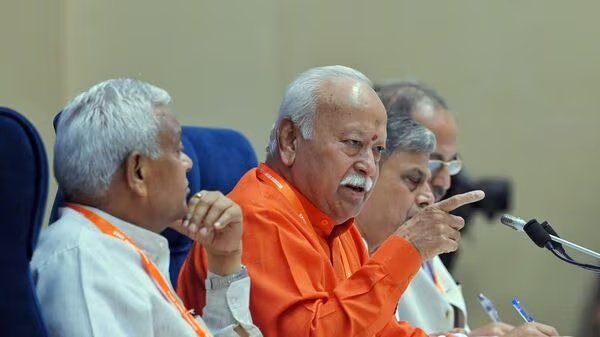
The first question is about the values in education. Questions put up by- Ravindra Shishodiya ji, Sanjay Sharma ji, Rajini Khandelwal ji, Anoop Kumar Trivedi ji, Harpal Singh Dangar ji, Vinod Kumar ji, Vikas Gaur ji and Ravindra Shishodiya ji.
The first question is: in the era of technology and modernization, how does the Sangh see the challenge of conserving values and traditions? Do you feel that the education system of the country still carries a glimpse of slavery? There is a lot of room for improvement in both the educational and administrative systems. As a Sangh, how can we improve this system?
In missionary schools and public schools, in the name of education, thousands of years of tradition are being destroyed. Students are reading English novels and history books written by leftist writers. How can we bring them back to the mainstream?
The next question is: can Rang Manch be made compulsory instead of being kept only as a co-curricular activity at the school and international level, so that students can connect with their art and culture from childhood? What is your view on this?
There are two more related questions. What efforts are being made to connect Bharatiya Vedic Gurukul education with mainstream education and to teach the 64 arts of Vedic learning to students? How can those working in this direction be supported?
The last question in this group: what is the Sangh’s view on making Sanskrit language compulsory from class 6 to 12?
Response: Technique and modernity are not against education. As man’s knowledge increases, new techniques emerge. No one can stop them from coming. They arise because man has something good in his hands—yet that is also why they can be misused. The use of technology lies in the hands of man.
If any technique arises, it should be used for the benefit of humanity. If it is going to have negative effects, then one must protect oneself and others. Humans should control technology, not the other way around. In the olden days, it was said: first the wrestler moves the shaft, later the shaft moves the wrestler. Today it is said: earlier phones used to listen to us, now we listen to what our phones say. That should not happen—and that is why education is necessary.
When technology falls into the hands of the uneducated, we cannot tell what direction knowledge will take. It can even be disastrous. Education means not just literacy or cramming information. True education makes human beings cultured, social, and humane. If such education is available, then even poison can be used as medicine. That quality of education is required.
The true education of our country was lost long ago. It was deliberately destroyed. A new education system was introduced so that we remained slaves to foreign invaders. They wanted to rule this country, not develop it. Their policies and processes were designed for control, not progress.
But now we are independent. We no longer have to rule the country; we have to care for its people, develop their mentality, and instill pride in them—pride in our heritage and capacity. That change was necessary. In recent years, awareness has grown, and efforts have been made to bring these elements back into the education system. Some things have already been done, others are on the way. But changing the education system and even in administration—is essential.
For example, let me share an old story from my days as a Pracharak in Nagpur. A gentleman from the Income Tax department in Kerala, belonging to the IPS cadre, once came to meet me. He wanted to meet Atal Bihari Vajpayee. I told him this was not the office for that, but he insisted his message could reach from here. He explained that he wanted to raise a question about the dress code.
In Kerala, he said, he wears veshti/mundu and kurta to work, sometimes uniform for police duty. But in Nagpur, on a hot day, when he dressed in kurta-Pyjama, he was scolded for not following etiquette. He went to Khadi Bhandar and bought a Kurta Pyjama Jacket, but was told even that was not acceptable—the rule was a full Western suit, tie, etc. He said, “How can this work in such heat? We will boil inside.” He wanted to know when this would change.
I told him to write to Atal ji in Delhi. Later, when I discussed this, people said our administrative services even teach “drinking etiquette.” That may be relevant for cold Western countries or for those in foreign services, but why should it be imposed on everyone? Such things must change.
Of course, I am not saying everything is the same as before independence. There has been change, since now the administrators serve the people. But gaps remain. We need to make those changes, and there is no reason to be apprehensive about it. Everywhere, people should learn their traditions and values. It is not about religion—it is about society. Our religions can be different, but our values and culture bind us together.
Drinking etiquette is fine. Western regions are cold, they must need these remedies.
So there’s etiquette for that. The people who go to foreign services may have to get trained on drinking. But what is the need to teach this to everyone? So some changes should be made.
I’m not saying that nothing has changed. After independence, there will be some change, because now people have to be taken care of. But there is still a gap.
So all those changes should be made. And there is no need for a lot of apprehension in this. Everywhere, everyone should teach their tradition, their values, their values. It is not religious. It is social. Our religions can be different. As a society, we are one. Understanding this, it is common. Like giving respect to parents. Is this forbidden in any religion? Keeping humility in front of elders. Not being subordinate to ego.
All these things are special. And look different. In other places, there will be reasons for it. I am not saying it is bad. But it is good. So this should be taught. And this is universal in a way. There is very little difference. Good manners, they are nearly universal.
But while eating, whether you eat with your hands or not, this is different. But these small things are universal. So it is not so that if you read English novels, that you won’t understand this. We are not English. We don’t want to be English but English is a language.
What is the problem in learning the language? In our home, we have been in the Sangh Tradition for three generations. And there is no lack in the values of the Sangh in our home. When I was in the 8th grade, my father taught me Oliver Twist.
He taught me Prisoner of Zenda. I have read many English novels but that hasn’t reduced my love for Hindutva
It doesn’t make a difference if we treat a language as just a language—if we analyze, study, or read it for its subject matter, there is no negative effect. But if I read Oliver Twist by Charles Dickens and never read Premchand’s literature, that is not right. We have such high quality literature, from the Ramayana to the Mahabharata. Look at the stories of the Upanishads—the tradition continues even today. Every language has a rich tradition.
That’s what should be learned, and taught to everyone. Whether it’s a missionary school, madrasa, or any other institution… Religious education is a separate matter. But when it comes to moral goodness, we all share one heritage: the tradition of India, passed down since ancient times.
For example, when Mr. Arif Baig visited (I was Nagar Pracharak then—he came as president for Akola’s Vijayadashini Utsav), he discussed the traditions of this country: how beneficial they are for everyone. He gave an example—The jewels that Sugriv and the other Vanars (monkeys) found, had to be checked to determine whether they belonged to Maa Sita. So he called Lakshman and asked him to identify them. Lakshman said, ‘Show me the anklets—I can only recognize those, because I have never looked at Sita ji’s face, I have only seen her feet.’ The values the culture this moment reflects is indomitable and great, it is equal for all—it should be taught to all. Our religion does not get undermined by it; on the contrary, it becomes stronger.
This must be understood, and these values should be imbibed by everyone—yes, we will start small, my individual strength and yours… It will occur in missionaries too but today we can begin with ourselves. We must commit to this.
In our new education system, the concept of Panchakoshiya Shiksha has been adopted, emphasizing the holistic development of all aspects—art, dance, yoga, and more.
All this must gradually be developed. As I said, in the past our education had gone astray, flying off at a tangent, but revival has started and it continues.
The entire process takes time, and that’s understandable. Therefore, it’s vital that every human being possesses some element of art within. As the ancient saying goes, “Sangeeta Nrityam Kala Vihinah, Sakshat Pashuh, Puchh Vishan Hinah”—meaning, a person without music, dance, or art is, in essence, like an animal deprived of tail and horns. Not needed to be skilled in every art, but every person should have at least some inclination or appreciation for it. One should be able to recognize a good song, understand its melody and its essence—not on a purely intellectual level, but with feeling. This sense and sensitivity to art is, simply put, essential for the fullness of being human. In our tradition, an individual who is untouched by these experiences is likened to an animal without a lion’s tail—a vivid metaphor suggesting the absence of something vital and distinguishing.
The key is that this appreciation should arise on its own, instead of being instilled through compulsion, because I feel that when something is forced upon, there is a resistance to it .
For example—a man had a dog, and the doctor said to give it medicine. The process instructed to him; hold the dog firmly, open its mouth, put the medicine in, and don’t let go until it swallows. The first day, it worked; by the third day, the dog sensed what was coming, so the dog ran away exactly at 8 o clock. One day due to all the mishap the medicine bowl fell and spilled. The owner cursed and left it., but noticed the dog licking up the medicine voluntarily. So, with compulsion, the effect is different—remove the compulsion, and the natural tendency emerges.
Similarly, in music and dance, there is an innate urge or inclination that must be awakened gently—not forced or imposed compulsorily. This natural awakening should be allowed to happen and tested, whether at home or in schools, where it might even occur more easily.
My own appreciation for music grew because my uncle was a good singer and a radio artist. Thanks to him, records for practice used to arrive at home, and whether we liked it or not, we listened. Our teachers assigned poems to us, and we all sang together in class. Our language’s poetic verses were rich with rhythm and melody, preparing our ears and kindling a natural attraction to music. This is how it should happen.
Today, however, family life is often disconnected from this tradition, and this trend needs reversal. Schools must also help foster this connection. Unfortunately, sometimes school syllabi omit singable, beautiful poems altogether, which must be addressed. Compulsion alone does not work. The 64 arts of Vedic times, those still relevant today, should be taught. The mainstream education system should be reoriented to revive and integrate Gurukul methods—the ancient Indian system of holistic learning.
Interestingly, Finland has an education system closely resembling Gurukul, unparalleled worldwide. There, teachers are university-trained and teach children in their local language up to grade eight, with a student-teacher ratio of about ten to one. People go to Finland to receive such education, and they accept owing to less population. In the first four grades, education is experiential—living and interacting with teachers rather than formal classroom work. This closely mirrors the Gurukul style of personalized, experience-based learning. The only thing which is not similar is the practice of residing in an ashram; it reflects the best teaching practices, which must be blended into our mainstream education.
The same is true for the Sanskrit language, which holds great importance. Why is there a need to enforce it? To truly understand our traditions and Bharat itself, knowledge of Sanskrit is invaluable. It allows direct access to original sources without mistranslation or language barriers, which often lead to misunderstandings. I recall being sent from home to take a Sanskrit exam during school. Killa Paradi exams were going on. Initially, I disliked it. But at home, I memorized Sanskrit stotras and later witnessed how Sanskrit Bharati’s teaching methods made fluent spoken Sanskrit classes enjoyable even for those who were not that familiar with the language.
The essence of good teaching is that the teacher must be excellent and able to instruct at the student’s level to kindle interest. Teaching is not mere external pouring of knowledge—it is the art of awakening the innate knowledge within, a key principle in the Sanskrit tradition. Therefore, we should promote and propagate Sanskrit learning, teach Sanskrit stotras at home, and share engaging cultural details. For instance, the line “Takram Chakrasya Durlabha” means that buttermilk (mattha) is hard to attain for god Indra too.
Before this line, three intriguing questions are posed, and within those two more elements have been put. Jayantah Kasevi Suta? Katham Vishnupadam Prokta? So whose son is Jayantah? This is the second question. The answer to the first question is buttermilk(Matha). Bhojanante Chakim Peham? Mattha. Jayantah Kasevi Suta? Indra. Jayantah is Indra’s son. Katham Vishnupadam Proktam? How is Vishnupad? Durlabha. So three questions are asked. In the last line, three answers are written. Takram,Chakrasya, Durlabha. Inferring: Buttermilk is rare for Indra. This is how it was taught to us. These methods foster interest. Such a method naturally motivates children to study Sanskrit. At the very least, one should have a basic understanding of the Sanskrit language. Anyone who wishes to understand India must have access to knowledge of Sanskrit.
Question put up on Bharatiya Gyan Parampara – Dr. Raja Gopalacharya, Ayurveda
Question: a) What is the initiative taken by RSS or its subordinate organizations on the propagation or popularization of the Indian knowledge system?
b) What measures are envisioned for the future?
Answer: RSS does not have subordinate organizations. The organizations in which swayamsevaks (volunteers) are working; are independent and autonomous; they are expected to be self-dependent. There is no form of subordination in the RSS structure. As an organization, in RSS, we sing the Ekatmata Stotram every day.
Within the Ekatmata Stotram, it begins with, “Sachidananda Rupaya,”—a salutation to the God.. Following this, the Matru Bhoomi is worshipped. The rivers and mountains of Bharat are then named, honoring the country’s geography. Subsequently, from the Rishi Parampara to Scientists, all are mentioned.
Vaidyanika Ashtakapila, I am mentioning the last one; I will leave out Rishi Parampara now. Personalities such as Ashtakapila, Karnadha, Sushruta, Charaka, Bhaskaracharya, Varaha, Meera, Sudhi, Nagarjuna, Bharadwaja, Aryabhatta, Basu- Jagdish Chandra Basu, Basura Buddha, Gheyo, Venkataramastra, Vidya, Ramanuja, and Daya are included.
Thus, from ancient times till today, the tradition of Scientists has been included in a representative form. We recite this daily, and during the training in Vargas, detailed information is provided about each individual mentioned. This is an ongoing and continuous process in the Sangh that has been followed for many years. Over time, these lists are revised and made more contemporary. What I have described is the current practice.
So, what was the Indian knowledge? In our Bhaudhik Varg, there is a subject: “India’s knowledge tradition.” From spiritual wisdom to the scientific tradition, everything is included. Soni ji is present here; his book is there—it is quite popular even outside the Sangh. So, our subject has always been to uphold India’s knowledge tradition.
Now, even in the field of education, four organizations are working on this. Through their efforts, this subject has also been incorporated into the new education policy. Previously, the term “Bharatiya Gnyan Parampara” was barely heard. In fact, saying it used to be somewhat of a taboo. But today, when attending Shiksha Sammelan or various gatherings around the country—even in universities—people openly discuss the Indian knowledge tradition. They talk about IKS, IKS (Indian Knowledge System). If we continue to strengthen these efforts, it will be even better. Our organization remains committed to this cause.
Question put up by: Ajay Rastogi ji, Abhishek Dubey ji, Reema Sharma ji, Joginder Solanki ji, Rajneesh Jha ji, Ashik Hussain ji, Rajesh Kumar Bansal ji, Atul Tare ji – Swadesh Samooh’s Editor, Joginder Solanki is media personality, Sanjay Jha ji is senior journalist, Vasudha Venugopal is senior journalist, Dr. Rajesh Bansal is Director in Hospital Administration, Abhishek Dubey ji is senior journalist in Bharat 24, Reema Sharma is media person, Dr. Prabha Kumari, Harpal Singh Danggar Ji is social service person, and Mangesh Jant Vaishpayan from Maharashtra Times.
Q. a)Why are we (RSS) not getting good coordination with the government? We should make good or more efforts to make good adjustments with some compromises to achieve the goals of the country. The RSS has more responsibility than the government.
b)What are the issues of the current central government and the related topics of the Sangh? Looking at the extensive expansion of BJP and the favorable conditions created due to it, is it time to reconcile the Sangh-BJP relations and re-establish them?
C)Everywhere it is said that the BJP’s head prepares everything together. Is this true?
Answer: We have good coordination with every government, not just this one(BJP). With the state governments as well as the central government. Yet, some systems have inherent contradictions. As I mentioned, the general administrative system we follow is essentially the same as it was created by the British for governing India, to facilitate their rule. Therefore, it is imperative for us to innovate; without that, progress will not happen.
Often, we wish to see certain changes. Even if the person in office is entirely supportive, they are still bound by existing constraints. They are aware of the obstacles. Sometimes, they may be able to achieve the intended goals, and sometimes they may not. We must allow them to work freely, there is no conflict anywhere.
Thirdly, the prevailing trends globally are also similar—contradictions exist. For example, take the Mazdoor Sangh, a labour organization and a small-scale industry organization. Under the current social system, they naturally end up at loggerheads—there is a struggle for existence, and survival of the fittest. Such conflict is inevitable. There is an opinion that progress can be achieved only through struggle. Consciously or unconsciously, willingly or unwillingly, we all operate within this framework. So, for a labour organization, a small-scale industry association, the government, and the political party, an agreement between all is rare. And when the topic of compromise arises, it leads to a question: “Why should we compromise? Why not you?” Thus, even discussions of ‘compromise’ often deepens the conflict. Therefore, our stance is: let everyone proceed according to their own approach. Conduct your experiments, and if you achieve the desired results, those outcomes will be accepted by all.
Because our Swayam Sevaks are honest in their work, they do not believe in “isms,” or rigid ideologies. Certainly, there is thought and intent behind every action, but it is not about following an “ism.” Each idea is tested in practice, and whatever yields results is accepted. With this approach, there is no conflict or quarrel. It may seem as though these two groups are opposed, but genuinely, they are not—both are searching for the truth, and that search inherently involves some struggle.S
Take, for example, a railway yard. If one must move a rail from one track to another, it is never a straightforward path, since there are many tracks and obstacles. The rail is pulled here, then there, finally reaching its destination. The path is circuitous, not direct. All these complexities create the appearance of conflict or struggle. There might indeed be a struggle, but there is no real quarrel, because the goal is the same: “The welfare of our country and our people”. When this understanding is shared, coordination naturally follows. This understanding is embedded in the way our Swayam Sevaks work.
Differences in opinions can exist; it is not necessary for Dattaji and I to always think alike. We discuss, form a consensus, and then, regardless of whether the final decision aligns with or differs from my own view, I accept and support the collective outcome. When this attitude is in place, discord does not arise.
So, what about the issue of differences of opinion? There is actually no issue with having a difference of opinion. Everyone holds differing views on certain matters. In our country, differences of opinion are natural, but there is never a difference of heart or mind. We have trust in one another that whatever we are attempting, it is being done honestly and without selfish motives. Our capacities are our own, our circumstances are our own. Even if we pursue separate paths, the destination remains the same—everyone must reach the same place.
And the idea that everything is decided by the Sangh is completely incorrect. That is simply not possible. For instance, I have run Shakha for fifty years, so if someone seeks advice about the Shakha, I am an expert in that area. But they have managed the country for many years, so they are experts in that field. I acknowledge their expertise as much as they respect mine. In these matters, we can offer suggestions. We can advise, but the decision belongs to them in their domain, and it is ours in our domain. That is why we do not make decisions for others. If we were the ones making all the decisions, would it really take so much time? We do not do it, nor do we need to. Take your time—there is no compulsion from us.
Question: What is the Sangh’s opinion regarding the law of imprisonment of political leaders?
Answer: See, our leadership should be transparent and clean. This is the fundamental principle. I believe everyone agrees with this, and the Sangh agrees as well. Now, this is the law. Whether it will happen or not is still debated. The final decision-making authority is of the Parliament. Whatever is decided, that will happen.
But what should be the outcome? The outcome should be that our leadership is transparent and clean. Everyone should have faith in this. That is what we need to ensure.
Question: a) Why doesn’t the Sangh support other political parties?
b) Some political parties seem to be against the Sangh. Do you see the possibility of change in their minds?
Answer: Not only possibilities, we have witnessed people changing their minds completely . In 1948, Jai Prakash Babu was on the verge of burning the Sangh’s Karyalaya with a torch. After the Emergency, he came to our Sangha Shiksha Varga and said that the hope for change lies with you. Some publications will emerge after the completion of the century, some released before….there are mentions of many… from Maulana Abul Kalam Azad to more latest, Pranab Daa (Pranab Mukherjee) came to our stage. He did not change his mind or opinion, but whatever misunderstandings he had about the Sangh were cleared up. That is why he came. So, if a person’s mind changes—after all, a person does have a mind—there is always the possibility of change. Sometimes it happens very quickly; sometimes it takes time. The possibility of change in the mind should never be denied. This is our attitude.
We help those who ask us for help to do good work. Those who seek our assistance receive it. If someone runs away, we do not help them. What else can we do? “Is there any good work to be done?” We ask and act. Everyone asks. You may only see help given to one party, but to run the country, or sometimes to run a party, if it is for greater good, our Swayamsevaks provide support from the Sangh.
In Nagpur, there was a session. There was a problem with the food system, and a lot of violence erupted. Those who were there at the time know what happened. Rajiv Gandhi was heading the session. Plates were thrown, and all kinds of unrest took place. The messes were closed. There were about 30,000 people. Some individuals entered and looted the markets. When they were beaten back, they retreated. I received a call—I was the Pracharak of Nagpur then. The MP of that time called me. He said, “Bhagwatji, we need your help to restart the messes.” There were 11 messes, and in 7 of them, we sent our Swayam Sevaks. The messes had been closed, but we managed to reopen them by 2 pm.
So, we have no problem. The entire society is ours. We do not consider anyone an outsider. There is no obstruction from our side. If there is any obstacle from the other side, we respect their wishes and cease our efforts.
Question: The next question is related to employment.
The questioners are Kamal Ghanshala ji, C.A. Sanjeev Nanda ji, and Pandit Ram Kumar Sharma ji.
In the last few years, the number of private universities in India has increased rapidly. The level of education is falling rapidly due to the business of education. A degree-level unemployed group of people is getting ready, which is completely unskilled. What solution does the Sangh see to this problem?
Answer: Education is pursued for employment; this mindset is ingrained in the human psyche. Why do we need a degree? We need it for employment. For example, I studied agriculture. There were many Agriculture Veterinary students in our university. Many of them are still with me. I was pursuing post-graduation. After graduation and post-graduation, these individuals did not take up careers in agriculture. Instead, they went to work in banks, signing papers as loan officers, while farming continued only on paper—not on the farms.
There were 70 to 100 acres of good agricultural land in households, with water and pumps available. Yet, they did not return to their profession. Why? Because earning money is associated with doing a job. It is commonly believed that being a government official is very prestigious, and having an office close to home is considered convenient. This mentality drives everyone toward jobs. But if you want to earn, you need the skills to do so.
We will not become slaves. We will not become servants. We will become employers. If you adopt this mindset, then the enormous pressure on employment will be reduced by half. And those who think like this become successful.
Once, I met a university registrar who said he teaches business skills to people who cannot afford formal education. He mentioned that he has empowered 400 children to stand on their own feet.
He told me an example. There was a boy who used to wash utensils in a hotel. He asked him, why did he not study further? The boy said he had left school in the 8th standard. Why did he leave? Because he was not interested in studies and also did not have the money. He asked him what he wanted to do. The boy said he wanted to do some business. He asked what kind of business. The boy said he wanted to run a paan (betel leaf) stall. So, he started a paan stall. How much does it cost to set up a paan stall? He spent 4-5 thousand rupees. That was 10 years ago. For a year, he went there daily to eat paan and asked him questions like, “How much stock was bought today?”, “From where?”, “What kind of accounts does he keep?”, and “Whether he had taken any loan?” He taught him business for a whole year. He used to go twice a day for paan. That day, he told me that the boy now owns property worth 29 lakhs in a village near Shirdi.
So, by working, one can make a living and also benefit society. There is one small but important fact: no sector in the world, be it private or government, can provide more than 30% of the jobs. The rest are earning in small and big entrepreneurs on their own.
But there is another problem—these small and big jobs have become associated with work that has existed since ancient times. This work is light. There is impurity in this work. That’s why it’s labeled “light.” It is not light; it is considered impure. Since this mindset took hold, our society began to decline. The value of hard work gradually diminished. Now, hard work is necessary, and hardworking people need to be respected.
Why don’t people take up farming? No one gives their daughter in marriage to a farmer. Even if he is a good farmer and earns well, he lives in the village and is a farmer. He is educated, but he doesn’t get a bride. What does this mean? It means hard work is not respected.
So, cultivate hard work. Destroy the notion that living means having a job. Encourage youth to become strong enough to earn for themselves and their families. This way, the people of India will not only work for their own country but also provide a workforce for other nations. Such potential must be brought forward and fully utilized.
HOST: Just as the issue cannot be resolved without the BJP and the Sangh, in the same way, without addressing demography, DNA, and the concept of Akhand Bharat (Undivided India), the issue remains unresolved.
Here are the names of those who raised the questions—
Anjali Rai Mehta ji, film producer, Yatendra Sharma ji, senior journalist, Mamata Chaturvedi ji, senior journalist, Suresh Chavanke ji, senior journalist, Dr. Gladbin Tyagi ji, Ramanpuri ji, retired Vice Admiral, Indian Navy, Dr. Mamata Tyagi ji, Ashok Srivastav ji, senior journalist, R. K. Gupta ji, retired IRS officer, Jitendra Tiwari ji, Harshvardhan Tripathi ji, Professor Anil Mitra ji, Professor K. G. Suresh ji, senior journalist, Peter Hornung, German journalist, Lieutenant General Ved Chaturvedi ji, Professor Manjusha Rajgopal ji, Syed Sherwani ji, Pawan Gaur ji, senior journalist, Maulana A. R. Shaheen Qasmi, Muslim scholar, Sukesh Ranjan ji, senior journalist, Vijay Trivedi ji, senior journalist, Colonel Tahir Mustafa, Registrar, Hamdard University, Sandra Pettersman, German journalist, Anil Tyagi ji, Tyagi Samaj, Chaudhary Shrindar Solanki ji, Pradhan, Parliament 360, Dr. T. S. Klair, Ambassador Sujan Archanai, Gopal Kishan ji, retired IRS officer
Questions of Part 1- The Demographic DNA and Akhand Bharat
- How will India address the concern of removing unlawful immigrants and managing the imbalance in population? And what is the viewpoint of the Sangh on this?
- You say that the DNA of Hindus and Muslims is the same. But then, how does extremism override this shared identity?
- Referring to the Quran, Sunnah, and Hadith—how do we deal with those who practice political Islam based on these?
- If the DNA is indeed one, then is it justified to exclude Bangladeshi immigrants?
- Why did the Sangh not oppose the Partition? And what is the Sangh’s position on a country like Pakistan?
- What is the Sangh’s vision regarding Akhand Bharat (Undivided India)?
- India has long been rooted in the principle of Vasudhaiva Kutumbakam (the whole world is one family). Yet, why have India’s borders become restricted in the past few centuries?
- Is the unification with our neighboring countries something that can truly be envisioned?
Answer: So, there is indeed concern about demography. And the reason is that when the demographic balance changes, there are inevitable consequences. The Partition of the country itself was one such consequence. I am not speaking only of India—look at Timor, look at Indonesia. In many countries across the world, there is worry about demographic imbalance.
But why does this anxiety arise? More than the actual numbers, the matter of intention gives rise to doubt in people’s minds. First thing is numbers. What are the causes behind this imbalance in the population? The first cause is religious conversion.
Conversion is not a part of the Indian tradition. Even representatives of the Catholic Church tell us that they do not encourage it. In fact, even in Christianity, there is a tradition where conversion is not considered proper. Very recently, I was speaking with Madarsa teachers, and they too said that in Islam, conversion is discouraged. The Prophet’s uncle was asked to recite the Kalma, but he refused. If that is so, then these forced acts of conversion should not occur. Religion is, by its nature, a matter of personal choice. Whoever wishes to follow one religion may do so, and if they wish to return to another, they may do so as well, but willingly, out of their own volition—not through coercion. Yet, such practices occur. Therefore, to prevent imbalance, this must be stopped.
The second factor is infiltration. It is true that, in essence, our DNA is the same, but a nation is also defined by its systems. Take Europe, for instance—there are three or four countries with the same ethnic ancestry, yet they are organized as separate nations. A country is a system, and systems must have boundaries. So, is it right to stop infiltrators? I would say, if the DNA is one, then it is not wrong to come—but surely it must be with permission. If one comes with permission, it is legitimate. But to enter by violating rules and regulations is wrong in itself. it has been observed that problem arises once they enter, and this corruption must be stopped.
The government is doing something about it, though progress is gradual. But ultimately, society too must play its part. We must provide employment primarily to our own countrymen. There are Muslim citizens in India, and they too require jobs. If we wish to employ someone, why not give the opportunity to an Indian Muslim rather than a foreign infiltrator? Those who come legally, with valid permission, are welcome, as we see in every country of the world. But those who come without authorization—such cases must be identified. If a security concern arises, authorities must be informed. Don’t employ such individuals. In this way, the problem too will reduce.
The third issue is the birth rate (janm darja). Normally, one may not ask such things openly to a Pracharak. But since the question has been raised, let me say this: all the world’s scriptures have noted that communities with fewer than three children gradually fade away. Therefore, the minimum requirement for stability is more than three children—and this is seen across societies and countries. Doctors too confirm this. They say that having three children not only benefits family stability, but also contributes positively to the health of parents and children. In families with three children, the siblings grow up learning to manage differences and egos—this strengthens family harmony. Now, I am a veterinarian, so this does not fall within my field, but this is what human doctors tell me.
Our nation does have a population policy, which recommends a replacement fertility rate of 2.1. At present, India has reached this mark in terms of average. This is acceptable. But let us understand: in mathematical terms, 2.1 means roughly two. But in the case of human birth, there is no 0.1 after two—there is only three. So, 2.1 effectively implies three children. Each Indian citizen should see to it that they have three children. I say this purely from the perspective of the nation.
At the same time, population is both an asset and a burden. Tomorrow, each individual must still sustain themselves. For this reason, population policy recommends balance—neither excess nor shortage. There must be stability, and three children are sufficient to achieve this. Raising them properly requires care, so going beyond three is not advisable. This is a principle that all communities must accept. Now, it is true that birth rates are reducing across all groups. But Hindus had already reduced earlier, so in their case, the fall is more visible. Other groups were not reducing as quickly, so comparatively their numbers appear larger. But over time, even they too are reducing—nature itself imposes checks when populations grow excessively.
Therefore, my point is: no group should fall below three. At least three children must be raised to sustain society. Those who still have the opportunity should take this step—for the sake of the coming generations.
Now, you asked about Partition. Why did the Sangh not oppose the Partition? This is misinformation. There is a book by Shri Seshadri titled The Tragic Story of Partition—all of you should read it. It describes in detail how Partition happened, what consequences it brought, and what might have prevented it. The exact role and opinion of the Sangh is clearly presented there—without any concealment.
The Sangh, in fact, did oppose Partition. But what strength did it have at that time? The entire nation stood behind Mahatma Gandhi. He himself said: “I will be the last man standing against Partition.” Guruji and our workers relied on his word, trusting that there would be no Partition. But later, Gandhi ji too agreed to it. When Mahatma Gandhi himself gave assent, society no longer supported the Sangh’s position. It is because of this turn of events that Partition couldn’t be stopped. On our own, we, too, could not prevent it. That is the truth behind Partition.
What happens after Partition? In 1946, Abul Kalam Azad was interviewed by the a journalist of Chattan daily, in Lahore. I do not recall the exact date, but you can look it up. In that interview, he spoke out against Partition and predicted its consequences—what would happen to Pakistan, what the condition of Muslims in India would become. Today, we see his words have come true. But voices such as his were not taken seriously at that time.
Yet, despite this, India remains unbroken. This is a truth and a fact of life. Those who deny this reality—what became of them? They said we are separate, we are different. Seventy years have passed since. Look at their condition today—have they achieved happiness, materially or spiritually? No. There have been numerous efforts in all these years, but they did not yield lasting solutions. For how could there be a solution while deliberately clinging to division? A limb cut off from the living body loses vitality—it becomes numb, lifeless.
There is only one solution: to recognize that by culture, ancestry, and motherland, we are one. We must live by this truth. Keeping Akhand Bharat in mind is not merely a political concept. Even when Akhand Bharat existed, there were many kings, many borders, and wars between them. One often required permission to cross boundaries. Yet, the people—ordinary citizens—felt deeply connected with the land, from north to south, east to west. They traveled, worked, traded, and still experienced a sense of unity and belonging.
If once again such a feeling of unity is awakened, then politically, economically, culturally—society will progress in every direction. Peace will prevail, friendships will grow stronger, and all will flourish. This, to me, is the true vision of Akhand Bharat. The dream of unity is not merely a dream—it is inevitable that one day we shall awaken to it. For ultimately, the one who sleeps, also wakes. Akhand Bharat exists—it is a reality. We need to recognize this truth and move forward together.
The Demographic DNA and Akhand Bharat
- For many Muslims, it is not easy to grasp the linguistic and cultural identity embedded in the word “Hindu.” Even though they have no hesitation in describing themselves as Indian Muslims, the connotations of the term “Hindu” remain difficult for them to fully accept.
- There is also the matter of demolitions involving Muslim religious sites. In instances of atrocities against Muslims, it is often alleged that the Sangh’s volunteers are the first to take the lead. If this distance and distrust between communities continues, how then can India truly become strong and prosperous?
- Even after seventy years of independence, Hindu-Muslim tensions and conflicts persist. Why is it that we still struggle with this? Why can we not rise above these divides and stand united simply as Indians? Who is to be blamed for communal violence, and, more importantly, who has the ability to put an end to it?
- Another issue arises with the practice of renaming cities and roads that currently bear names of Muslim origin. Do you think it is right to change those names? If the Sangh maintains that “it is not against the Muslims and Christian communities of India,” then why does it seem so difficult to convince those communities of this sincerity?
- Furthermore, how can we ensure that minorities in India—particularly Muslims and Christians—embrace a sense of shared consciousness with regard to our common past, history, and cultural heritage?
- Finally, does not our repeated emphasis on the principle of Vasudhaiva Kutumbakam—the ideal that “the entire world is one family”—dilute our position and resolve when it comes to the question of illegal migration?
Answer: (Especially in reference to Bangladesh.) In my speech the day before yesterday, I had said that the word Hindu conveys a particular essence, a cultural substance—and that is why we consciously call ourselves Hindus. Now, some may say Hindavi, some call themselves Bhartiya (Indian), some say Arya, or others even say Indic. But we understand that these are all synonyms. If people prefer one of these expressions, we respect that. Yet, the cultural essence, the ancient tradition, the spiritual content that I refer to—today, the only word that truly expresses it is Hindu.
So, we will continue to emphasize it. You may prefer to use “Bharatiya,” knowing that it means the very same thing. You may call it Hindavi. We don’t mind. We are not here to quarrel over words. What matters is the essence—the cultural content we mean to express. We don’t demand anything beyond that. But unfortunately, because of words, categories like “Hindu-Muslim” have been created. I sometimes wonder: why do we speak of “Hindu-Muslim unity”? Unity between whom? To unite those who were never truly separate? In essence, we are already one. What really has changed? Worship practices have changed. But what else?
Fear was propagated: “If these people live here, what will happen tomorrow? So many conflicts, so many massacres, even the country was partitioned—be alert!” That is one narrative. On the other side, a different fear was created: “If you go along with the Hindus, then Islam will be lost. You must be separate from them, otherwise you will have no identity.” Both are wrong.
Maulana Abul Kalam Azad—in his interview from those times—had said, “Religion does not change nationality.” Even Arshad ji once told me that his uncle had also declared the same. Our identity is one. We are Hindus. We are Bharatiya. Call it what you want—but the identity is one. Our culture, motherland, ancestors, and tradition are the same.
And when we forget this, even after seventy years, disbelief remains. On one hand, Hindus doubt if Muslims truly belong to them—because of their own weakness, their own lack of confidence. They wonder: “Are Muslims really ours? After all, they pray differently…” But our tradition has always said—“Bhavna jaisi, Prabhu murat dekhi tin taisi” (The Divine is seen according to the devotee’s faith). Forms of worship may differ, but the underlying reality is one.
On the other hand, Muslims too have insecurities. They wonder: “If we walk side by side with Hindus, will our Islam remain safe?” This doubt arises because of forgetting spirituality, forgetting inner strength. Therefore, strength must be reawakened in one community, and misconceptions must be removed in the other.
From the day Islam came to India until today, it has remained—and it will remain. Anyone who thinks otherwise is not speaking from a Hindu thought. Hindu philosophy is not like that. What we require is confidence, from both sides. Then this struggle will end.
First, we must accept: we are all one. Our languages may be different, our castes, our practices of worship or dietary habits may be different—these are all diverse specialities. But above all is the nation. Above all is our society, our shared culture. We are not a union of separate sects or communities—we are one people. As the Constitution says: We, the people.
As for the changing of names of cities and roads—that reflects the sentiments of the people. It should always be aligned with public sentiment. And names should not glorify aggressors. Do not mistake me: I am not saying that places should not be named after Muslims. On the contrary, names should honor those who inspire us—like Shaheed Havaldar Abdul Hameed, or Dr. A. P. J. Abdul Kalam. The matter is not of religion, but of patriotism and inspiration. Who gave sacrifices? Who elevated us as a nation? Just as Ram Prasad Bismil inspires us, so does Ashfaqulla Khan. Faith, worship, customs of food—these are not “differences” in our culture; they are respected as unique features. But as a society, as a nation, we are one. The conflicts that arose from our historical baggage must gradually come to an end.
So, renaming is not about being “against Muslims.” It is about ensuring that our shared spaces honor patriots—not invaders. That distinction must be kept in mind.
Now, to the allegation that the Sangh has fomented atrocities, and why does the Sangh does not foster trust: Can I ask how many Swayam Sevaks have been caught committing atrocities, hurting people? I am not asking for proof. Did Hindus as a community attack Muslims? Did the Sangh attack Muslims? Show me the proof. Yes, there may have been incidents where people fought each other on the street, but that is a different thing. People will retaliate if attacked on the road. But has there been any systemic atrocities committed by the Sangh members against any community? Exceptions can be there… But the Sangh’s tradition is one of selfless service. Why then is this narrative of fear allowed to spread?
People say: “But how many examples are there of the Sangh serving in times of crisis?”
Consider the plane crash at Charkhi Dadri—all the passengers were Muslims. The Sangh volunteers served them tirelessly. Remember the floods in Kerala, the earthquake in Gujarat—was religion ever asked? Service was given to all alike. Yet, a narrative has been spun that has distorted public perception. We must put aside this perception, and look instead at what are the real facts. The truth is clear to those who have worked in these situations. The allegation that the Sangh engages in violence is completely false.
Yes, sometimes, when wrong has been done in society at large, even by Hindus, I myself have condemned it openly and directly. You know this. How then can one say “the Sangh did it”? It is unjust. The Sangh hides nothing. Whatever we do, we do openly. Even today, Muslim brothers have been invited to this gathering. I don’t talk about the Hindu nation. Our position is plain. You are welcome to come and see for yourself anytime. Then faith will grow—faith in the Sangh and in Hindu society. For neither the Sangh, nor Hindu society by nature, is as it is portrayed by such allegations.
When this distrust is erased, Muslims and Christians too will feel connected to our shared historical consciousness and culture. But for that, this narrative that divides worship, faith, and religion from culture and nationhood must stop. Yes, a Muslim may say “I am Muslim,” a Christian may say “I am Christian.” But they are not Turks or Arabs or Europeans. They are Bharatiya. Their ancestors were Bharatiya. Once their leadership begins to assert this truth openly, mistrust will dissolve. Hindu society is waiting for this eagerly.
And as for Vasudhaiva Kutumbakam—I have already spoken. The whole world may be viewed as one family. But within a family, every member is distinct. Each individual has their own dignity and responsibility. Similarly, in the world, every nation has its own sovereignty. Freedom requires discipline—it is not mere license. You may have the freedom to act, but not to strike your neighbor’s cheek. That is where freedom ends—discipline begins. Thus, when we say “the world is one family,” it does not mean illegal migration should be accepted. On the contrary, even in a family, order is necessary. For the larger whole to function well, the rules of each home must be respected.
This is why illegal migrants should not be allowed entry into the country. There is no question of discrimination in this—it is simply how a well-organized family, or a well-governed society, must operate. The rules must apply equally to all.
Here are the names of those who raised the questions—: Acharya Dr. Kaushal Panwar ji, Abhay Kumar Tiwari ji, Shri Manmohan Padam ji, General Secretary of Akhil Bharatiya Balai Mahasabha Pradeep Kumar Mohanty ji, Gopal Krishna ji, retired IAS officer Prabhat Kumar ji, Ratan Lal Bairwa ji, and Sanjeev Kumar ji, these are some of the respected individuals whose questions have been compiled. The questions have been divided into two parts, first part is-
HOST: Our commitment is towards the vision of “Ek Bharat, Sreshtha Bharat”, but the question arises: is casteism not a hurdle in this path? Does the Sangh recognize that the caste hierarchy weakens the unity of Hindu society? The slogan given by Shri Mohan Bhagwat ji at Aligarh, “Ek Mandir, Ek Kuwan, Ek Samshan”– carried a powerful message, yet its impact is not visible on the ground. Could deeply entrenched caste practices be the reason for this gap in implementation?
Answer: Casteism is a hurdle. Whenever something turns into an “ism”, it becomes an obstacle. What we call caste and varna was once a system, but today it is no longer a system, it has turned into disorder. Under the name of caste and varna, pride and ego are running the show. What we truly need is a new, time-relevant order, one that is free from exploitation and rooted in equality. Outdated structures have to go; we need not worry too much about their departure, only ensure they do not create turmoil as they fade away.
The real problem is not in the system anymore, but in our minds—in the arrogance of saying, “I belong to this caste, I belong to this varna.” And equally, in the inferiority complex of thinking, “Oh, I am from this caste, from this varna.” If arrogance ends, so will inferiority. What we need is natural, respectful interaction. As I said yesterday, real harmony comes not from speeches but from living together—visiting each other, sitting together at home, sharing meals. These are the true bonds of oneness.
I’ll give you an example. Yashwant Rao Kelkar once had a new Karyakarta from the Scheduled Caste in the Vidyarthi Parishad. Some people provoked the young man, telling him, “They are just using you. Soon, they’ll make you sweep floors.” Upset, he went to Kelkar Ji’s house one hot afternoon and rang the bell. Kelkar Ji opened the door and warmly said, “Oh, you came in this heat! Come in, sit down. What’s the matter?” The boy, still angry, said, “I’ll tell you, but I’m very thirsty.” Kelkar Ji replied, “Of course. Go inside the kitchen, get some water, and bring a glass for me as well.” The boy did so. Later, when asked how it went, he simply said, “Nothing, it’s all fine now.” This is the kind of natural, effortless behavior we need—not through arguments or logic, but through the heart touching another heart.
When this spirit is practiced, everything else naturally follows. Our Swayamsevaks are making such efforts. But since these issues are so deeply rooted, pulling them out completely and seeing the full impact of ongoing efforts will take time. Bharat is vast, and today’s media has become highly regionalized, what happens in one place often doesn’t reach another. That is why the impact of good work is reduced. At times, news that should never spread goes everywhere, while the positive stories that truly deserve wide attention remain unheard.
For example: Among you sits an invited guest who is a Swayam Sevak of the Sangh. He had gone to Bhopal. Yesterday was Ganesh Chaturthi, and during the Ganesh festival, some people approached him for donations. He said, “I will buy the grandest idol you want, but only on one condition, every community in this settlement must join together in the puja and aarti.”
In that settlement, he created such an atmosphere, and indeed, it happened exactly as he envisioned. This is the kind of effort our swayamsevaks undertake, both individually and collectively. In Madhya Pradesh, surveys were conducted regarding access to temples, water sources, and cremation grounds. In many villages, these age-old divisions have already been erased. Not everywhere yet, but many villages have already changed. Such work cannot be forced, it requires conviction, patience, and time.
Take Palamuru district in Telangana, or rural Maharashtra during the Ram Janmabhoomi movement. Our karyakartas organized events that brought all castes together in the village temple. Once people came together a few times, long-standing restrictions on darshan dissolved on their own, without a word of protest.
This is the kind of quiet but powerful impact Swayamsevaks are making. Surveys should record such results. If the results are positive, they will inspire enthusiasm. If not, they will guide us to improve. What matters is that the work is being done—and wherever it is done, real change is visible. For this change to spread across the country, we also need your cooperation in amplifying these positive efforts. With that, the atmosphere will transform.
Question: Does the reservation system fuel casteism, or does it hinder social harmony? What is the Sangh’s position on this matter? You have said that though we are different, we are still one, Hindus. But when a woman from the lower strata of society is violated, why does the Sangh’s voice of protest not come across with conviction?
For centuries, a section of Bharatiya society has borne the burden of maintaining cleanliness, yet today they remain neglected and distressed. What steps will the Sangh take to ensure their rightful representation? There are also references to caste divisions in texts like the Manusmriti and the Vedas, what is your perspective on this?
Even after a hundred years of the Sangh’s intense awakening campaigns, caste-based divisions in society are becoming more pronounced. When will we truly be free from this?
Answer: Issues such as reservation. Discussions on subjects like reservation can only be truly understood when one approaches them with empathy. Our organization once debated a proposal on caste-based reservation. At that time, just as society often witnesses fierce debates, a similar clash of views occurred among us. There was no physical conflict, but two diametrically opposite opinions confronted each other.
Our Sarsanghchalak then, Shri Balasaheb Deoras, patiently listened to the entire debate. At the end, he said: “Imagine being born into a family that has endured the pain of caste discrimination for over a thousand years. Place yourself in their situation, and then speak in the next session.” When the assembly met again, the proposal in favor of reservation was passed unanimously. This shows that the matter is not of arguments and calculations, it is of sensitivity and justice. How much benefit or loss each one gets, if you try to argue over it, there will be no solution through arguments alone. Injustice was done, and there must be full compensation for it.
Arguments exist on both sides. Some say: injustice was done, hence full corrective measures are needed. Others argue: those who committed the injustice are long gone, why should we suffer today? Both points carry weight, but neither provides a true solution. Pandit Deendayal Upadhyaya explained it best: if someone has fallen into a pit, they will raise their hand to climb out. But they can only succeed when someone standing above bends down and offers their hand. This is the only way forward.
All these debates often continue endlessly, full of arguments and counterarguments. But I say this openly, and I especially tell the youth: If our own people have suffered for a thousand years, and if we must bear some burden for even two hundred years to lift them up, what difference does it make? One must be willing to sacrifice something for one’s own people, that itself is Dharma. Just the other day, I gave the example of King Shibi Rana, who cut his own flesh to protect Dharma. In the same way, when we give up something, all of our society ultimately benefits.
That is why we must act, even if it causes us some minor inconvenience. Without developing the right sensitivity, this issue cannot be truly understood. The Sangh has always supported the reservation provisions enshrined in the Constitution, and it will continue to do so until the beneficiaries themselves feel that it is no longer necessary. Only when they say, “The social discrimination has ended, now we can stand on our own,” will the need end. Until then, as I have said many times before, the Sangh’s role is to stand firmly in support of reservation. When will that day come? It will come only when the injustices and atrocities mentioned in this very question cease. Unfortunately, they still continue. And whenever they do, Swayamsevaks rise and stand strongly against them.
Their view is that in such matters we must step in, examine the situation, and always stand on the side of truth and justice. But the fact remains that the Sangh’s strength is not present everywhere. At the national level, the Sangh is strong, but what influence does it have in my own village? That varies from place to place. Even where the Sangh is strong, it is not always visible that its workers have taken a firm stand. Sometimes it may be because they truly did not intervene, and that is their shortcoming, their fault. We must correct such weaknesses. Yet, our intent is clear, that whenever such situations arise, Swayamsevaks should step forward, prevent conflicts within society, and ensure justice by standing firmly for truth and fairness.
This is what is expected of our Swayamsevaks. If, for various reasons, it does not happen, then it is still our failing. If such shortcomings are brought to the attention of the local Swayamsevaks, they will be addressed. For the weaker sections of society, we shall continue to make efforts to secure their rightful reservation. But let me add, merely making efforts is not enough; it must also be done with clarity of purpose.
People often say that the Sangh supports reservation merely to expand BJP’s vote bank. This should not be the case, because such assumptions create misunderstandings on both sides and divert attention from the real issue. We believe it is more appropriate that the leadership for the upliftment of a community should come from within that community itself-leadership that is genuine, selfless, and rooted in integrity. While such leaders may represent their own community, they must also see themselves as part of the larger society. Our efforts are directed towards nurturing such leadership, and they will continue. Through this, a true solution will emerge. On the side of justice and truth, the Sangh has always stood firm and will always remain steadfast as a matter of principle.
If such references are found in some other scriptures, we do not accept them. It is possible they exist, but in 1972, all our religious leaders gathered in Udupi and clearly declared that notions of untouchability, superiority, inferiority, or “untouchables” have no place in Hindu Shastras. Therefore, even if such a reference appears somewhere, it must have been misinterpreted. We should not tamper with those scriptures, because Hindu history is vast and contains countless texts. Even Manusmriti, though often cited, was rarely the actual guiding practice for the majority of Hindus.
In our tradition, there are two authorities: one is the Shastra (scripture) and the other is Lok (the will and practice of the people). As the saying goes, “Shastrāt Rudhir Balee”- meaning, in the end, it is the will of the people that prevails. What is written in books and scriptures is not always how society lives. That is why we do not have just one binding text, and interpretations of the scriptures have always differed, each adjusted according to people’s convenience. Throughout history, the country has never run entirely on Manusmriti or any one text. The majority of society lived by its own practical customs and needs. The decline in respect for labor gave rise to the idea of high and low status. What began as a sense of cleanliness and uncleanliness was distorted into notions of purity and impurity, and from this, social hierarchy emerged. When and how this started is not clear, but the root of the problem lies there. The true remedy is to recognize that all members of society are equal parts of one whole.
Every section of society has its own role to play. There is no concept of high or low, everyone holds equal dignity, and all are our own. This spirit of unity must be awakened, and the Sangh is working towards it. Scriptures are not the central issue here. Scriptures and Smriti (traditions) have always evolved with time, and now there is a need for a new Smriti. Our religious leaders must reflect and create such a framework, one that includes every section of Indian society, across sects, sub-sects, castes, and sub-castes, and that guides them towards practical and harmonious conduct. This is essentially a movement of awakening. Today, caste equations are gaining importance in politics. If that political lens is set aside, what remains to be done is what I mentioned yesterday, regular goodwill meetings. Community leaders must continue to sit together and reflect on three core principles. Let politics run its own course, but society must not be divided into two parts. There should be no fragmentation within society, that is what truly needs to be achieved.
Question: Some questions have come in on social issues. Here are the names of those who have raised them: Mr. Avinash Sharma, Mr. Love Tomar, Mr. Rajneesh Kumar, Mr. Sunil Majhi, Mr. Pritam Sharma, Dr. Manmohan Singh Chauhan, Mr. Vijay Singhal, Mr. Amok Kumar Mishra, Mr. Ashwini Parashar, Mr. Khemchand Sharma, Mr. Kailash Gotuka, Mr. Dinesh Gupta, Dr. Prem Kumar Shukla, Mr. Shailendra Mishra (DD News), Mr. S. Raja Raman, Ms. Sonam Singh, and members of the Namdhari Sangh Seva Samiti.
Their questions revolve around the concept of Panch Parivartan (Five Transformations) that you spoke about yesterday. How can families be instilled with strong values and a deeper sense of civic duty? How can Indian society be awakened to its greater responsibilities? In this period of social change, how do we ensure respect for the elderly, guide our youth away from addictions, and prevent the erosion of trust in marital relationships?
Furthermore, how can we inspire a collective spirit of service and environmental responsibility at religious sites, the Kumbh Mela, and other places of pilgrimage and tourism?
Answer: Let me give you an example. Our environmental initiative once made an appeal regarding fairs and tourist spots. That simple call—“Thali-Thaila” (use a plate and cloth bag), received an overwhelming response from across the country, and even the akharas accepted it wholeheartedly. Why did this happen? Because the people who made the appeal carried credibility, and their suggestion was both practical and addressed a problem everyone already felt. It offered a real solution, and so it was immediately accepted. This shows us something important: credible voices in society must step forward with practical solutions and intervene in community spaces—whether it be fairs, festivals, or pilgrimages. For instance, take the grand Ganesh Utsav celebrations currently happening in Maharashtra. The Vishwa Hindu Parishad and similar groups often encourage organizers to include programs on nationhood, culture, values, and traditions. If this is not done, the celebrations are reduced to little more than DJs playing music, two rounds of aarti, and people gathering for prasad. But imagine if, alongside these, there were lectures, competitions, and activities that nurtured knowledge, character, and understanding. Such interventions are within our reach, and they are what we must actively pursue in our own local contexts.
About the values to be instilled in families, I already spoke in detail yesterday. A booklet for this program may also be prepared, which will reach you in due time and answer your questions. You can also go through some of my earlier speeches. There will be a bookstall outside where a collection of speeches is available, and you will find all these points covered there as well. For now, to save time, I will speak about the awareness of civic duties. Such awareness is shaped through examples, and for that, knowledge is essential.
What is a citizen’s duty? I would say, the Preamble of our Constitution itself is the essence of citizen duties, citizen rights, and guiding principles. These four chapters of the Constitution should be introduced right from middle school, starting from Class Five. Every student must be familiar with them, and we too, as citizens, must understand and practice these duties. Only then will the next generation truly learn. Awakening comes this way, through examples and through genuine connection. It is the heart-to-heart sharing of ideas that makes them travel from one place to another. And for the one who speaks, their words must be backed by action. It does not have to be so overwhelming that it frightens people; it should be visible and inspiring, yet not beyond human reach. One must always stay a few steps ahead of the people, guiding them steadily, and in time, everything falls into place.
Q: What is the opinion of the Sangh regarding Artificial Intelligence?
A: It’s not that every task must be done by the Sangh alone. You can do it too; it’s something everyone should participate in. Of course, the Sangh will inform its swayamsevaks because as Artificial Intelligence becomes more prominent, we’ll need to incorporate it into our activities. This information will also come from our side. Along with sharing its benefits and drawbacks, and its ethical considerations, we’ll need to guide on how to use Artificial Intelligence. We’ll do that—now as it’s arriving, we’re gradually moving towards it. Our entire program is geared towards connecting the youth with the nation and with Dharma. Sometimes, it may look like they’re just playing on the field or doing experiments, but in reality, our people are deeply connected to the nation and to Dharma. We’ve been doing this for a hundred years. The questioner should come and see for themselves what really happens; only then will they truly understand.
Q: There are some questions about the religions and faiths that originated in India. Do you have any? Yes, at the end, tell us about the national language. Have you read about it? One moment.
A: When we say ‘national language,’ it means all the languages whose roots are in India—they are national languages. You asked, “One is national, what about the rest?” No, all our indigenous languages are national languages. What we need for certain is a common language to communicate amongst ourselves. We do not need foreign tongues, because our deeper feelings aren’t easily expressed in foreign languages. Take for example: Shri Gopal is a cowherd—there’s no equivalent in other languages. Even for ‘Dharma,’ there isn’t a true poetic equivalent outside our languages. All our Indian languages have special words for these concepts. We need one Indian language as a common thread. Whichever it is, let’s decide collectively, commercially or otherwise, let’s just do it. That’s our opinion—there’s no point in debating over languages. The words may differ but the sentiments are the same.
Take Tirukkural for instance, or the Abhangs of Tukaram Maharaj, or the Chaupais from Ramcharitmanas; they all carry deep, equivalent meanings. There are so many short, practical teachings—lessons in conduct—found in all languages. The ideals they uphold are the same everywhere. The Ramayana exists in every language, so does the Mahabharata—they’re read in every tongue. The wise words of saints resonate in all languages, whether it’s Sarvatra, Thiruvalluvar, or Uttar’s Sabyasin. So what’s the use in debating over languages? Naturally, we should know our own mother tongue well, and we should be proficient in the language spoken where we live. And we should learn a common language. If someone wishes, they’re free to learn all languages—there’s no harm in it.
Learning all the languages of the world is an asset. But at the very least, these three—mother tongue, local language, and a common language—should be known. So don’t fight over this. All the languages are ours. Let’s treat them that way. Let’s move forward.
Q: The next question is about the birth of religion and faiths in India. The questioners are Vijay Kumar ji, former Chief Director Pradeep Kumar ji, Ashok Kumar Singh ji, Rajveer Singh ji, Varghese George, Tarlochan Singh ji, former MP Nirmal Kaur ji, retired DG Police Jaginder Pal Singh ji, and Jaswinder Kaur ji. The question is: India is the land of Buddha, so peace is sought after here; then why does the Sangh talk about weapons and war? Why doesn’t the Sangh believe in equality? Why is it called a Hindu nation and not a Sanatan nation? Does the Sangh change its views over time? If yes, then what are the stable views of the Sangh? On which issues can this slow change be observed? Where and how can the Sangh be contacted? This is the second part. Let’s take the first part first.
A: India is the country of Buddha, peace is naturally expected here — and indeed, peace is something we desire and uphold. However, the rest of the world is not the land of Buddha. They practice the language of war. That is why the need for weapons arises. As I mentioned yesterday, when we engage in physical training, it’s not with the purpose of attacking anyone. When we advance our weapon capability, it’s not to use it against anyone. If having weapons meant we wished to kill, then we would have done so by now — but time and again, even though we possess the means, we refrain, because our intent is not bloodshed; our intent is to keep peace. Truly, we are the country of Buddha, but not every nation shares these values. Therefore, there is always a need for self-protection and a deterrent. In the Sangh’s prayer, we say, “ajayaan ch vishwasya dehish shaktim” — meaning, “Grant us invincible strength.” We never ask for the strength to conquer others, only for strength so that no one can conquer us. This is necessary, and it is appropriate.
The Sangh believes in unity. There is uniqueness and there is diversity; we accept everyone’s beliefs. And despite that diversity, equality exists as the basis — be it Hindutva or Sangh, that is our foundation. People sometimes get confused by the term “Sanatan Rashtra.” When we say “Hindu Rashtra,” everyone immediately comprehends; that’s just our experience. That’s why we use that term. Yes, we do adapt with time. There are three firm principles we hold: First, by nurturing a person, society itself changes — that’s our practice. Second, society must be organized; the rest falls into place thereafter. There is no reversal — you never see the horse behind the cart. First, society must be transformed, then the systems will resolve. Systems are run by people, and those people come from society — they evolve by the environment of society itself. Third, India is a Hindu Rashtra. Beyond these three, everything in the Sangh is open to change and adaptation. On all other matters, we accept ambiguity.
Q: Under Article 25 of the Indian Constitution, Scheduled Castes are granted access to temples. Why then are Sikhs, Buddhists, and Jains included in this provision? Sangh undertakes efforts to build the nation, shape character, and protect dharma, as the Sikh Gurus did. Shakha instills physical fitness, character, strength, and compassion, as Sikh Gurus did through Gatka. Why aren’t these similarities between Sangh and Sikh tradition more clearly conveyed to society? Will the Sangh sit together with Sikh scholars to bridge gaps between Hindus and Sikhs? Finally, to eliminate discrimination between Sikhism and other sects, will Sangh, together with senior Sevaks and Sikh intellectuals, continue dialogue among all? Can Sangh’s participation in Sikh festivals be a positive step forward?
A: Yes, we are already taking such steps, and there are suggestions for further progress. These positive actions are underway and we will expand on them. However, if we speak out directly right now, the circumstances aren’t favorable for such remarks to be received as intended. The environment should be cultivated so that such efforts are welcome. So yes, we’ll proceed, but as asked in the second part — just as the Sikh Gurus acted, and Sangh too acts in similar fashion — instead of us saying so, it’s much more effective if those outside Sangh recognize and articulate these similarities; change will be swifter and more effective. Our stance is that all must have entry to temples — we want all temples to be for everyone, for Hindus, and for all included. Why were Sikhs, Buddhists, Jains specifically included? There is no need for separate rules; anyone may enter. If there are specific rules or restrictions, then it is up to each tradition to decide; Sangh doesn’t impose on these matters. Entry for Scheduled Castes is already granted — that’s established.
Q: There are other questions regarding education from Nitisha Yadav ji, Pandit Ram Kumar Sharma ji, Dr. Raj Kopalesh ji, Sanjeev Nanda ji, Kapil Pyasi ji, Anoop Kumar Trivedi ji, Vikas Gaur ji, Harpal Singh ji, Vinod Kinkar, Sandeep Thakur ji, Kamal Ghanshala ji, Sanjay Sharma (India News), Rajni Khedwal ji, Kuwar Shekhar Vijendra ji, Rakesh Kumar ji, Ashish Ranjan Prasad ji, Dr. Markandeya Ahuja ji, and Prem Kumar Shukla ji.
Just as health facilities should be complete and affordable, so too must religious knowledge and values be available. But how can this happen? Is there a need to reform the education system? There are also questions about technology and youth.
A: The answer to all these questions is the same as the answer given to the first one. How can language evolve alongside technology? Engagement with people through new technology will be key. Yesterday, Ashok Chakradhar ji was here sharing his experiences — he works in artificial intelligence. He said AI is like a child; you have to teach it. He taught it Sanskrit: grammar, poetry — and the AI learned to create poetry. If we take care to ‘feed’ the right inputs to these new technologies, our objectives will be met through them. One realization from my own experience: What comes to my mind, you can always correct and contribute, because language, words will be supplied — but will emotions be conveyed? For example, I might say “You are a great scholar” and also “You are a great scholar” — it’s the same words, but can technology or artificial intelligence bring out the emotional intent? I am not sure. That’s why I don’t use it much yet; I only speak about it.
Q: The curiosity to understand the Sangh is natural. This question comes from Mujeeb Mashaal (Journalist), Rakes3at part did the Sangh play during independence? What role has the Sangh had in social movements? What other achievements have there been? How long will it take for your message of unity and inclusiveness to permeate to the grassroots workers? What is the Sangh’s plan for changing the economic, social, and political systems? According to you, in which areas has the Sangh not made an impact yet, and why is there a need for this?
A: Allegations are made — they have been made before — but these have never held true. The facts behind such false accusations have always come to light. Sangh has never conducted itself in this way. No organization accused of such things could reach 7.5 lakh places across India nor receive so much support; this is just common sense. If we had something to hide, we would have conducted our activities in secret or tried to circulate underground newspapers — but such behavior is, frankly, foolishness. Sometimes, as a coin gets rusted with age, so do these old accusations. So, there’s no need to get trapped in them.
The Sangh’s work in connecting people is not based on violence; its foundation is pure and sincere love (shuddh sattvik prem). Remember this. Dr. Hedgewar himself was a revolutionary who went to jail twice during the freedom struggle. He participated in Congress agitations, leading the movement in Vidarbha. In 1942, in Maharashtra’s notable Ashti and Chimur protests, the ones who sacrificed themselves were swayamsevaks. Those caught were hanged, and after World War II, those eligible for amnesty (eleven people, seven of whom were Sangh swayamsevaks) were released. With leaders like Tukdeji Maharaj, swayamsevaks took part in mass awareness movements, attending Sangh training camps and singing spirited bhajans at night — songs referencing stones becoming bombs, or grass into spears.
There are many such stories: Vasan Dada Patil was helped to escape from Sangli jail under tight police watch, carried 15 km on the shoulders of a swayamsevak named Parsal Gikar — I met him four times. Mrs. Aruna Asaf Ali sheltered underground at Lala Hansraj Gupta’s house, aided by Sangh volunteers. These kinds of companionships existed then and will continue. Until independence, Sangh was recognized with phrases like “Hindurashtra must be independent.” Now that independence has been achieved, the focus is on all-round development. Swayamsevaks have been involved everywhere, not directly as an organization, since the organization itself was not summoned — there were probably gaps in the planning. Still, Sangh’s support and solidarity with protestors and underground workers persisted wherever it was organized. There is evidence in many documents and, for more information, refer to Rakesh Sinha’s book “Dr. Hedgewar Charitra” (published by National Book Trust), Sanjeev Sanyal’s work (grandson of Sachindra Sanyal), or “Freedom Sangha” published by Surchi Prakashan in Delhi.
In social movements, Sangh’s desire is that achievements should be credited to society. Sangh does not raise separate flags or seek exclusive credit: it participates and supports ongoing efforts, regardless of the banner. For good work, our swayamsevaks have the freedom and expectation to get involved openly and selflessly — it is not something they need to be asked to do. Many swayamsevaks participate in numerous social movements. An achievement of the Sangh is preparing workers who are honest, selfless, and able to win trust; that is the main thing. The other achievements belong to the organizations where our workers have served. In summary, Sangh prepares the individual and will continue to do so.
Regarding how long it will take for unity and inclusiveness to reach the grassroots: No one can say exactly how long. For that, one would have to consult an astrologer! But as long as it takes, the Sangh will keep working — we do not rest until the task is complete. As for planning: Sangh itself does not make blueprints, it runs shakhas and prepares swayamsevaks; it is those swayamsevaks that develop plans. In every sphere — economic, social, political — more than one Sangh organization is active, gradually driving change.
For example, the labor union introduced a fresh perspective for labor relations, now discussed at the International Labour Organization. So, this process of changing the structure is ongoing.
But however long it takes, we are committed to working. We will not rest until our work is complete. That I can assure you. The Sangh itself does not have a fixed plan. The Sangh runs shakhas (branches) and prepares swayamsevaks (volunteers). These swayamsevaks formulate plans. In economic, social, political, and various other fields, one or more Sangh organizations are active. Through them, the system is gradually being organized.
As I mentioned, the Majdoor Sangh has introduced a new vision for the labor sector, which is even being discussed today at the International Labour Organization. This is part of an ongoing process of structural change. The Sangh is working to create such models in different areas. Gradually, these changes will take place. Currently, there are very few areas where we have yet to make an impact. But we will.
Within a century’s time, this is what we intend to achieve. After that, we will rise with our representation across all fields and continue our work.
Question: I have read some names in front of you who have asked the questions. I will read some more. Vikas Bhaduria ji, Anamitra Sen Gupta ji – Senior Journalist, Dr. S.Y. Qureshi – Former Chief Election Commissioner of India, Deepak Chaurasia ji – Senior Journalist, Mayank Kumar Agarwal ji, Amod Kumar Rai ji, Vivekanand Pranchpe ji, Nirmala Ganpati ji – Senior Journalist, Shri Avinash Tiwari ji – Senior Journalist from PTI, Shri Aman Sharma ji – CNN News 18, and Paritoshik ji.
The next question is, in the century-long journey, no householder has ever been made a mahasachiv or a sarsangchalak. As you start a new era, should we imagine that in the future, a householder will give a bhaudhik from the seat of mahasachiv?
The next question is, should Indian leaders retire at 75, and why? Does the Sangh feel that after 75 years, politicians should also leave the post? Bhagwat ji recently said that once you turn 75 and someone puts a shawl on your shoulder, one should retire. Many think this was a reference to Prime Minister Narendra Modi to retire at 75 years. What are your comments?
In the series, the last question is: Some time ago, you referred to the words of Moropant Pingle ji, that wearing a shawl at the age of 75th anniversary means that your age has come. Was that a hint to take sanyaas? Does the tradition of 75 years apply to a person who has been elected for 5 years? Answer: So, you have limited knowledge. The truth is, for a long time, and especially during the most difficult period of the Sangh, Shriman Bhaiya ji Dani, who was a good farmer and had a well-managed household, served as the sarkaryavah of the Sangh. It is not that a person who has domestic responsibilities cannot work for the Sangh or cannot come here. But after joining, one has to devote all their time. At the same time, a person with domestic duties must also take care of the household. The Sangh also expects that whatever work a swayamsevak does, it should be done well, they should equally look after their household.
His situation was such that his home was well-managed, and he could delegate household responsibilities and engage fully in Sangh work. So, he took on that role. Even today, as much as I speak for a day, our Anil Ji manages this well and is a person with domestic responsibilities. Our Sah-Sampark Pramukh Bharat Ji is also a domestic worker.
There are about 3,500 pracharaks in the Sangh, and the number of karyakartas, including those with small or large responsibilities, is around 5 to 7 lakh. We are a small, committed minority. But we are available because we are not confined to the home all the time. That is why more work is entrusted to us.
You have to understand it this way: The married ones, those with households, have entrusted us with responsibility and are pushing us from behind. They are the ones leading at the front, but the real responsibility rests on our shoulders. So, we are their workers. They have us sit here and honor us. That is why the Sangh is very unique. You will understand it when you come inside.
The rest is a matter of 75 years. So, I quoted Moropant ji. He was very very funny man. He was so witty that his wittiness made you bounce in your chair or your line, and it was very difficult to maintain the dressing.
Once, during one of our programs where all India karyakartas were present, he completed 70 years of age. Our sarkaryavah, Ishadri ji, presented him a shawl and asked him to say a few words. He was initially saying, “No, there is no need to… the shawl is also not needed” But then he stood up and said, “You may feel that you have elicited me, but I know that when a shawl is given, it means your time is up; now you should sit quietly in a chair and watch what happens.” That was his wit. His biography was inaugurated in Nagpur, in English, and I was speaking there. I narrated how witty he was, recounting three or four incidents. The Nagpur people had known him closely, so they thoroughly enjoyed it. I never said that I would retire or that anyone else should retire.
In the Sangh, we swayamsevaks are assigned a task whether we want it or not. So, if I am 80 years old and the Sangh tells me to go run a shakha, I have to go. I cannot say I have completed 75 years and want to enjoy retirement benefits. There are no such benefits in the Sangh. And even if I am 35, the Sangh may tell me to sit in the office. We do whatever the Sangh instructs. We don’t say, “I want to do this,” or “I want that.” No, that is not allowed. We are not here to pursue personal desires. We do as we are told.
I am the sarsanghchalak. Do you think I am the only one who can be sarsanghchalak? At least ten people here, sitting in this hall, can take this mantle and carry it forward in due time. But they are very busy, and their contributions are invaluable. They cannot be spared. I was the one who could be spared. So, this is not about anyone’s retirement, including mine. We are ready to retire at any time in our lives. And we are ready to work as long as the Sangh wants us to work. That is the reality.
Question: The whole of India flocked to Kumbh, but why did you stay away from it?
Answer: The same applies: wherever we are told to go, we go. I am here talking to you because our people have decided that this program must happen, and I have to speak. I also told them I spoke last time, so people might get bored hearing me again and again. I suggested having four different speakers for the four vyakhans, but they didn’t agree. So, I had to do it myself.
Similarly, I had planned to attend the Kumbh. But all our adhikaris had gone to Kumbh. The Sangh was there, but I wasn’t. Because we were told there would be a huge crowd at that time and that my other programs might get disturbed if I went. So, I was asked not to come.
I said, everyone is getting the opportunity to do a noble deed, and you’re depriving me. If the Sangh is not there to support me, I cannot say anything. But at least send me the water of Kumbh. So, Krishnagopal ji sent Kumbh water for me. On the day of Mouni Amavasya, I took a bath in that water in Kolkata. But now the Sangh is there, and because of it, I was deprived of that merit. I cannot do anything about it now. So, if the Sangh tells me to go to hell, then I will go.
Question: Next question is from Arun Kumar ji, Sahil Saigal ji, Shri Jant ji, Rajesh Kumar ji – Senior Journalist.
After 100 years, what does the Sangh think about its international role? How can Sangh work abroad?
Answer: The Sangh is working abroad—not directly, but through the organizations operating overseas. The Sangh supports the work of these organizations there. This is their method; they are carrying it out in this way, and the work of the Hindu Swayamsevak Sangh is progressing.
Each of these is a registered charitable organization in their respective countries. They have adopted the ideology from us. In India, the work of the Sangh is carried out by the Rashtriya Swayamsevak Sangh. If swayamsevaks are working outside India, then it is the Hindu Swayamsevak Sangh. It operates according to the laws of that nation.
But their approach is the same as ours. There is a shakha. There is a person responsible for managing work at the shakha. A person is involved in many activities of the Hindu community there. He connects with the local societies and organizations functioning there. All of this is ongoing.
I have also spoken about the international role. Worldwide, there should be one principle: people should leave their selfishness behind and move forward. From this perspective, each should run their country. Every country should preserve its uniqueness, maintain its boundaries, and adopt a contributory role. It should not function solely out of selfishness. To achieve this, we should stay in touch with everyone. This is not the work of the government but of people-to-people contact.
To increase outreach for this, we are planning to take action. Especially, we will first connect with neighboring countries. I said this yesterday.
Question: There are some simultaneous issues. The questions have been asked by Rajesh Kumar Thakur ji – Indian Express, Sanjeev Tripathi ji – retired IPS, Vasudha Venugopal Ji – Senior Journalist, NDTV, Sanjay Jha – Foreign Correspondent, Dr. Sitaraman Ramaji, Anamitra Sen Gupta Ji – Journalist, Anandabazaar Patrika.
According to constitutional provisions, is it right to receive foreign money to spread for votes, sects, and religions?
Is the Sangh making a plan against issues like Love Jihad?
How to reclaim Hindu temples?
Mr. Bhagwat ji said, food is not linked to religion. But in some BJP-ruled states, non-veg sales are banned during festivals. Does RSS support such bans?
You had said publicly that it was our wish to make a Ram Mandir, and we supported this movement. We don’t have any such plan for Kashi Mathura. Are you adamant on your decision as the Sangh Pramukh? Or is there any change in this?
What work is being done by the Sangh to remove superstition from a scientific point of view?
The opposition had raised some questions about Operation Sindoor. They were not seen standing openly with India. What is the Sangh’s thinking on this?
For the past few years, violence has been increasing in many ways. The protests are becoming more violent. It seems as if a war is being prepared. It seems that violence will increase in the coming days. What does the Sangh think in this direction?
Answer: Incoming foreign money for votes, sects, and religions is not a problem. If it comes for seva, there is no issue. But it must be used for the purpose for which it was intended. The question arises when it is spent on religious conversion. That is why it needs to be curbed. I believe that if money comes from outside for any work in any way, it is the government’s responsibility to scrutinize it and, if necessary, ban it.
Secondly, Hindu temples. The first thing that should be done is to recognize that not all temples are under government control. Many temples are private and managed by trusts. The condition of all these temples should be properly maintained. Because, in a way, the mindset is ready for the country, and the system is also prepared, so that devotees can be given temples for worship and should maintain their own temples. But devotees must have the vision that they themselves can maintain the temple. Some private or trust temples run very well. Some government-owned temples also function well.
However, the opposite is also occurring. The government controls some temples, but arbitrary looting is happening. Similar issues exist in private or trust temples. That is why this situation needs to be rectified first. A structure should be developed so that when temples are identified or found, they can be taken up accordingly. There should be a system, according to the sect or tradition, for worship, for the use of money offered to God, and for the use of money offered by devotees.
Such arrangements should be made by citizens and religious leaders of that sect or tradition at the local, district, provincial, and all-India levels. This way, when the court says, “We are giving this over,” people will be prepared to accept it. These preparations should be ongoing, and gradually, progress will be made.
Food is not linked to religion. But people do not eat on the day of fasting. During festivals, people try to eat only vegetarian food. At such times, if we see a scene where someone is doing something contrary in front of our house, our feelings may get hurt.
This is only for 2–3 days. During such times, we should avoid these actions. Then there will be no need to create laws for this. A person with wisdom should not be hurt by what others choose to eat.
Now, if there is a special occasion and they want certain things not to be visible to us, then understanding that sensitivity, I will also decide that since it is their festival, this should not be done. I will refrain from it. When this understanding is missing, laws and bans come into effect. These laws and bans do not focus on “don’t eat this” or “don’t eat that.” Their intent is to prevent conflicts arising from heightened emotions. From that perspective, they are appropriate. But this understanding should come from both sides—then such restrictions would not even be necessary. It’s not that those who eat meat do so every day, nor that vegetarians constantly see meat being consumed. This is about some special periods. One should show understanding during those times, and then such problems will not arise.
The Sangh does not participate in movements or protests. The only movement it participated in was the Ram Mandir movement. We joined, so we took it through to the end. The Sangh will not take part in any other such movements. But Kashi, Mathura, and Ayodhya—all three hold great significance in the Hindu psyche.
There are two janmbhoomis (birthplaces) and one niwas sthaan (residence place). Hindu society will insist on this, and according to culture and society, the Sangh will not take part in any other movement. However, Sangh swayamsevaks can go individually because they are Hindus. But except for these three, as I have said, don’t look for temples everywhere, don’t look for Shivlings everywhere. If I can say this as the pramukh of the Hindu organization, whom swayamsevaks often question, then there should be some leniency. It’s just a matter of these three—accept it. Why not? This will be a big step forward for brotherhood.
There is no superstition in the Sangh. There is a scientific perspective, and the swayamsevaks are taught the same. Rituals, etc., are not part of the Sangh’s shakha . Whatever one believes in, they are free to do, but we do not involve anyone in rituals. You must have seen here, we performed Pushpanjali and worshipped the Matru Bhoomi. Otherwise, we would have chanted mantras. We did not do that.
All the Sanskrit mantras recited in the Sangh are only for the Matru Bhoomi. In the Sangh’s prayer, first comes Mother India, and then God. And even for God, we do not specify Rama, Krishna, or Buddha; there is only God. Everything is in accordance with the Almighty. The one who is supreme—that is the Almighty. That is why we do not engage in rituals. This is not superstition. But since human beings have feelings, we respect those feelings.
Violence is increasing, movements have turned violent, and preparations for war are underway. This should not be allowed to go that far. Yes, there are forces in the world and in India that desire such conflicts. But if we overreact, the outcome will not be good. We must carefully plan and prepare for such situations. However, fear, hatred, and enmity must never arise.
Every time the Sangh faced a ban, the Sangh’s sarsanghchalak used to say something afterward. After the first ban, Guruji said, “दांतों ने अपने ही जबान को काट लिया इसलिए कोई अपने दांत गिराता नहीं है,” which means just as teeth sometimes accidentally bite their own tongue—but the tongue does not hold a grudge, nor do the teeth fall out—people living or working together should forgive minor mistakes and not break relationships over them. And after the Emergency, Bala Saheb ji said, “Forget and forgive.
Names of dignitaries who posed the question: Global scenario political editor India TV,
Shri Nivneet Mishraji; Rajasthan Patrika Delhi Bureau, Shri Arun Kumarji, IPS retired; Tripti Lahiri ji, senior journalist, The Wall Street Journal, Chief South Asia Bureau; Shri Subrindu Singhji, administrative officer; Shri Nitin Batriji, independent director; and Shri Khemchand Sharmaji, national media panelist.
Q: A country like America, recently, under the pretext of trade, is attempting to exert its domination over Bharat. Should we, as a nation, succumb to this pressure? What message does the RSS convey to the political leadership of the country regarding this issue?
There is immense turmoil in geopolitics. Many experts believe a third world war is imminent. We are unprepared for civil defense. How can we strengthen it? America is pressuring Bharat to halt oil mining. How should we respond? How would you describe RSS’s influence on Bharat’s economic policies, especially in trade negotiations with the US? How has the organization shaped the government’s trade policy toward the United States?
I spoke about this yesterday. International trade is important. It must exist. Nations maintain relations because of it. But trade must not be subjected to pressure. There is no friendship in coercion. Trade must be free, free from cravings or external pressures. We should not submit to such pressure. There is no need to emphasize this separately. While we may strive for self-reliance, the global framework is inter-dependent. We must embrace this. This is the thought of the Sangh—and if it reflects the Sangh’s stance, then it also reflects the consensus of its Sawaym Sevaks too.
What should be done while undergoing it? Certain decisions can only be made in the crucible of circumstance. This issue has now emerged before us, and we must confront it with resolve, for it is the necessity of the nation at this moment. The consequences of our decisions must be weighed with the utmost care, for they will shape the path ahead. However, the long-term dream is to operate independently and without pressure.
Therefore, we do not influence the government based on statements by leaders like Trump saying, “You must do this.” We do not act in such directions. The government has to manage its own affairs. What to do? They will decide.
In such circumstances, it is the duty of every citizen to trust and support the government’s decisions, because it is the government that must act, it’s their job. It must examine how to proceed, what challenges exist, and devise solutions. Whatever decisions it makes are our collective will. The fundamental principle is that free trade must prevail. Trade should never be coerced. I do not advocate “free trade” in name only. A person must be mentally free to act or refrain. This has all been said.
Cultural nationalism is unrelated to this. We are a cultural nation, not a political one. That is the essence. Yesterday, I explained how the nation defines itself. I noted that the nation is not founded on specific cultures or states, which may rise and fall. A continuous cultural flow persists—this is our nature.
HOST: Viksit India: What path should our nation tread to achieve a developed Bharat by 2047? What role can the Sangh play? There are questions concerning the media and the Sangh as well. How can misinformation about unethical relations and criminal behaviors in web series be curtailed? Why do the media portray Dalits and Adivasis as separate from Hindus?
What about the Sangh and women? Why does the Sangh have a separate branch for women? Why are women not integrated into the main organization? How can we connect more women with the Sangh? Does the Sangh have mechanisms to protect women? Women’s participation in the Sangh is low. How can this be improved? Finally, what is the Sangh’s vision for the future?
What should be done to create a developed India? First, we must learn to live and, if need be, die for the nation. These are fundamentals. There are many policies; if I explain, you will understand. The second is boosting productivity. If patriotism deepens, our country’s security will be assured. Enhanced productivity will steadily improve the economy. We should focus on doing things ourselves, creating ourselves, rather than depending on the outer world. We must address these realities. If we concentrate on these two priorities, the youth today are motivated to build our nation. They are moving beyond selfish interests toward national greatness. We need to give them guidance—this will make India self-reliant and developed.
We should chart our own developmental model based on indigenous ideas. This is vital. We witness economic consequences—So if the frontrunners are faltering; those behind must learn, adjust, and forge a new path. When will this happen? Only when we contemplate our identity, our goals, and our duties. Our development model must arise from this reflection. It will be uniquely ours—resolving today’s challenges. Yet we have not fully realized this model but are contemplating it. We need a complete paradigm shift—a 180-degree turn. Policymakers must find solutions beyond current constraints. Progress will be gradual but must remain mindful and intentional.
Why does the media act as it does? Why would it put emphasis on certain aspects and not others? The media should ask itself these questions. We view everyone as one—no one is distinct or alien. Everyone has resided in India from time immemorial. Though appearances vary, differences are superficial. Former tribes are now rural populations. After countless centuries, clothing, deities, and languages have changed. That is natural. Such transformations occur in every developing nation. Diversity naturally arises and is never erased in a growing nation. Significantly, India has preserved its multifaceted heritage, which we must honor and understand. Therefore, The media should reflect on this and aid in providing direction and shared values for the nation.
I have told you about women. Rashtriya Sevika Samiti started in 1936. Since then, it was decided that it will work there, We will run the branches among men. We will be parallel, we will not meet, we will help each other. And if there is any change in this, then we will have to tell the Rashtriya Sevika Samiti that now change, then we will change. We are following that promise. When they tell you to do it, then we will do it. Otherwise, we will help them. They now have 10,000 shakhas. They also have a little more than 50 pracharika.
That work is also increasing well. In all other work, men and women work together. And women also lead. In various sangathans. In the activities run by the swayamsevaks. In the organizations run by the swayamsevaks. The head of the Sewa Bharti is a woman. There are many such things. So, women are connected to the sangh in this way. And every swayamsevak’s home is sangh’s home, not just swayamsevak’s home. So, women are also connected. Many women know our culture better than our new head. Men have only 2-4 Geeti paths. While women have 25 geeti paths. This is the situation. So, we are connected. We are running with their support. We cannot ignore them. And we don’t want to ignore them. We want to organize the whole of this society. So, it is their role. It is a good role. It should be the same in the rest of the organizations. This is our wish. 50% are women. There should be representation everywhere. Their co-operation in the Sangh is not less. Sometimes, even holding our ears, they make us feel better. And all women can play a role. We have faith. We have equal status. We are equal to each other. Both men and women are equal to each other. So, if something has to happen, if nothing has to happen, then we can live alone. If something has to happen, then we need both together. This is the role of women. This is the status of women. We believe so.
We don’t want to declare Hindu state. It is there. Rishis and Munis have made it retrograde. The word Hindu is used now. It doesn’t need any extra declaration. It is true. If you believe it, it is good. If you don’t believe it, it is bad. You can try and see. There is no process of Sangh’s membership. Coming to the Sangh, coming to the Shakha. Where to go? First, you have to find Karyakarta. You have seen some faces even today. Find them. Or go to the Sangh’s website. There is a button, join RSS. If you press it, you will get a contact. They will tell you. There are so many things going on. You can be a part of it. But I have a request. But I have a request. Don’t go for listening and reading. Come inside and see the Sangh. By getting the feel of the Sangh, You can know RSS. RSS is a thing to be known by experience.
ALSO READ: “Rashtriya Swayamsevak Sangh Vyakhanmala Day 1: Read Full Text Here”