Patit Pavan Temple: How Veer Savarkar Sparked a Social Revolution Even Under British Confinement?

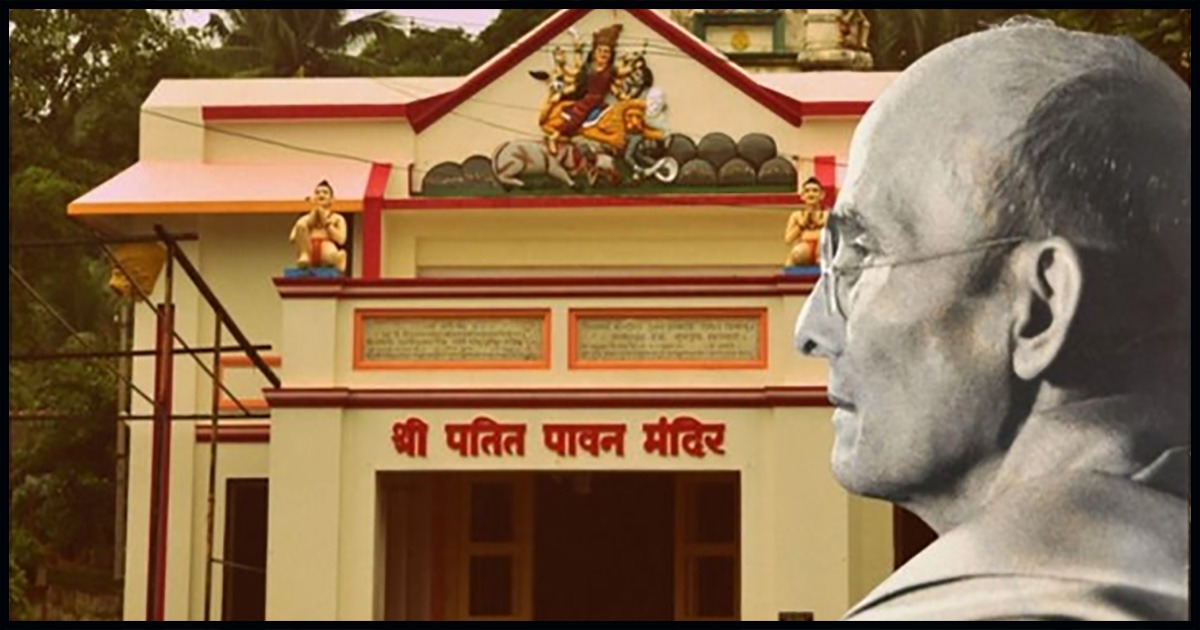
The period in Ratnagiri after 1924 proved to be a significant turning point in Veer Savarkar’s life. After the rigorous imprisonment in the Andamans, the British had interned him in Ratnagiri. Although he was prohibited from participating in political activities, his efforts to organize society did not cease. During that time, he closely observed the fragmentation and lack of communication within the community. Therefore, with the objective of making society unified and strong, he proposed the concept of building the ‘Patit Pavan Temple,’ which would remain open to all, irrespective of caste. In this article, we will explore the history of the establishment of that temple and the social thought behind it.
Meaning of the Word ‘Patit Pavan’ and the Establishment of the Temple
The meaning of the word ‘Patit Pavan’ is one who purifies the fallen. In Veer Savarkar’s view, this word was more important in a social and national sense than a religious one. In 1929, he clearly stated in a public meeting in Ratnagiri that if the Hindu religion is to survive, everyone must feel a sense of belonging towards it. From this thought, the decision to build the temple was made. For this initiative, Veer Savarkar himself interacted with the people, raised funds, and supervised the work.
As the next stage of this work, on March 10, 1929, on the auspicious occasion of Maha Shivratri, under the leadership of Veer Savarkar and with the financial assistance of Bhagoji Seth Keer, who contributed approximately ₹1 lakh at that time, the foundation stone of this temple was laid at the hands of Shankaracharya Dr. Kurtakoti.
Historic Rituals

Shri Vishnu Lakshmi | Photo Source: Darya Firasti
Two years later, on February 22, 1931 (Phalguna Shuddha 5, Shake 1852 according to the Hindu calendar) at 12:39 PM, the ‘Abhishek’ of the Shri Vishnu-Lakshmi (Patit Pavan) idols and the main ceremony of the temple were concluded. While the ‘Havan’ was performed by Shri Ganeshashastri Modak and the disciples of Masurkar Maharaj, Shankaracharya Dr. Kurtakoti personally performed the ‘Abhishek’ of the idols. On this auspicious occasion, the Savarkar brothers, various saints, leaders of the Arya Samaj, and a large number of leaders from all strata of Hindu society were present. People from all castes and communities came together and witnessed this ceremony while chanting slogans of ‘May Hindu Dharma be immortal.’
Social Equality and Universal Access
The greatest identity of the Patit Pavan Temple was that it was open to every person. While most temples in those days were entangled in specific customs, Veer Savarkar believed that a temple should be a place where everyone comes together. Therefore, asserting the stance that worship should be based on faith and not on birth, he granted all equal right to perform rituals and prayers in this temple. No one was prohibited from touching, entering, or seeking blessings here.

Patit Pavan Temple Ratnagiri | Photo source: News Bharti
With this very thought, a grand procession was taken out after the idol consecration ceremony. In fact, that day, the entire city of Ratnagiri had a festive and enthusiastic atmosphere, with saffron flags fluttering proudly everywhere. In this historic procession, thousands of Hindus came together. Notably, those between whom there was previously a social distance were now moving together harmoniously as parts of the same society, putting aside their biases. This unprecedented unity was the thread of equality woven by Veer Savarkar through eight years of tireless efforts. In this way, opening the doors of the temple to everyone proved to be the greatest success in Veer Savarkar’s struggle for social reform.
Other Steps Taken to Establish Equality
The Patitpavan Temple was not just a single initiative; it was part of Veer Savarkar’s broader social work. While in Ratnagiri, he promoted several initiatives such as community dining programs, keeping religious festivals open to all, lectures for social awareness, organizing the youth, training in patriotism, and starting restaurants open to all Hindus. Between 1924 and 1937, he organized hundreds of meetings, discussions, and programs to thoughtfully bring the society together. Notably, even after his release from Ratnagiri, his struggle for social reform continued uninterrupted.
This way, Veer Savarkar did not merely present the idea of equality through speeches but demonstrated it through direct action in the form of the Patit Pavan Temple. Therefore, this temple did not remain just a structure, but became a living testimony to his active nationalism and social revolution. Even today, this temple stands proudly as a source of energy, providing continuous inspiration to Hindu society for unity, self-respect, and remaining organized.