1813: The Clapham Sect’s Conspiracy, Missionary Infiltration, and How India’s Demography was Altered Forever

- All Hindu gods are impure and fallen.
- Their gods of wood and stone are not divine beings but demons.
- All Hindu doctrines and practices are mere pretence, corrupt to the core.
- All their traditions and beliefs are laughable and degrading.
- Hindu folklore and legends are steeped in deceit.
- Thus, Idol worship must be abolished. And this abolition will be achieved by spreading Christianity through the English language. This alone is the path to the “salvation” of Hindus.
The lines above are not fiction. Every sentence is recorded in history. This is the ideological history that prepared the ground for Christian missionaries in India. A history whose seeds were sown by Zachary Macaulay and his associates in the Clapham Sect, and which was given official sanction in the year 1813.
Why Christian missionaries should be sent to India, in what form, and with what objectives, everything was laid out in the Charter Act passed by the British Parliament in London in 1813. The much-discussed Macaulay education policy of later years became possible only because Zachary Macaulay, driven by deep hostility towards Hindutva, had already laid the foundations for the spread of English mannerisms and Christianity in India.
India Before 1813 and the East India Company
By the early 19th century, the East India Company had entrenched itself in India, financially and politically. It would not be an exaggeration to say that Indians had effectively become its subjects. Yet, at the social and religious level, the Company largely refrained from interference. The reason was simple: Trade.
However, pressure mounted from London. Trade was flourishing, so what was the pressure about? It was about infiltrating the Hindu religion and society. The Company resisted. Its officials feared that tampering with India’s social fabric could trigger rebellion, and rebellion would damage business.
Before 1813, missionaries did not have official permission to enter India and propagate Christianity. The East India Company repeatedly argued that this status quo must be maintained. The hardline Christian members of the Clapham Sect in London were unhappy with this, but commercial logic consistently prevailed until it did not.
The Clapham Sect was not prepared to concede defeat so easily. Their ambitions went far beyond short-term profit. They developed a theory of long-term rule based on the alliance of the Queen’s flag and the Christian cross. On this front, the East India Company lost. In 1813, the British Parliament passed the Charter Act. With it, the doors to India were officially opened for missionaries and their evangelising work.
What Was the Clapham Sect, and Why Does India Matter?
The Clapham Sect was a collective comprising merchants, mathematicians, priests, government officials, members of Parliament, writers, and bankers. Two things united them all: Immense wealth and uncompromising Christian zeal.
To appear progressive, they engaged in various philanthropic causes. But their real objective was the global expansion of Christianity. Their focus lay on missionary activity in India and Africa and on distributing the Bible across the world.
Prominent members included William Wilberforce, Charles Grant, Zachary Macaulay, the father of Lord Macaulay, and John Venn.
The earliest push to dismantle Hindu traditions, send missionaries to India, and teach the Bible to Hindus came from William Wilberforce in 1793. His bill was rejected by Parliament that year. Charles Grant later carried the mission forward. In 1813, they succeeded. Christianity now had an official licence to operate in India. Soon after, John Venn, an influential church figure, dispatched two priests from London. They arrived in Madras, today’s Chennai, on 4 July 1814 to begin their work.
Now to Zachary Macaulay. Certain figures are deliberately obscured in history through silence and omission. Zachary Macaulay is one of them. Put simply, if Lord Macaulay was the mason who anglicised India’s education system, his father was the engineer who designed the blueprint for English Christian penetration not only into Indian education but into Indian society itself.
Driven by such powerful and fanatically religious figures, mass conversions were carried out across the world, India and Africa being primary targets, through inducement, deception, and fear. It is for this reason that the nineteenth century is often described as the Great Century of Missionary Work.
Read once again, even at the cost of repetition, how Hindu beliefs were viewed by these missionaries:
- All Hindu gods are impure and fallen.
- They are demons, not deities.
- All Hindu practices are corrupt pretences.
- All traditions and beliefs are absurd and degrading.
- All folklore is deceitful.
- Therefore, idol worship must be eliminated by spreading Christianity through English education. This alone is the solution.
These lines bear repeating because they reveal the instruments and systems the Clapham Sect used to achieve its objectives, how contempt for Hindu traditions was seeded within Hindu minds themselves, even as the Christian mission advanced in parallel.
India After 1813: the Clapham Sect’s Phased Strategy, Education, Health, and Administration
Between 1801 and 1810, how many Christians were there in India? Fewer than one lakh. By 1871, the number had risen to nearly nine lakh, an increase of over 800 percent in seventy years. By 1881, it reached around nineteen lakh.
Using the 2011 census as a reference, Christians now constitute 2.3 percent of India’s population, exceeding the numbers of Sikhs, Buddhists, and Jains. This transformation was made possible because the Clapham Sect had already laid out and executed its strategy, embedding Christianity into education, healthcare, and administration. Schools, colleges, hospitals, and even ICS officers, today’s IAS, were aligned with church interests.
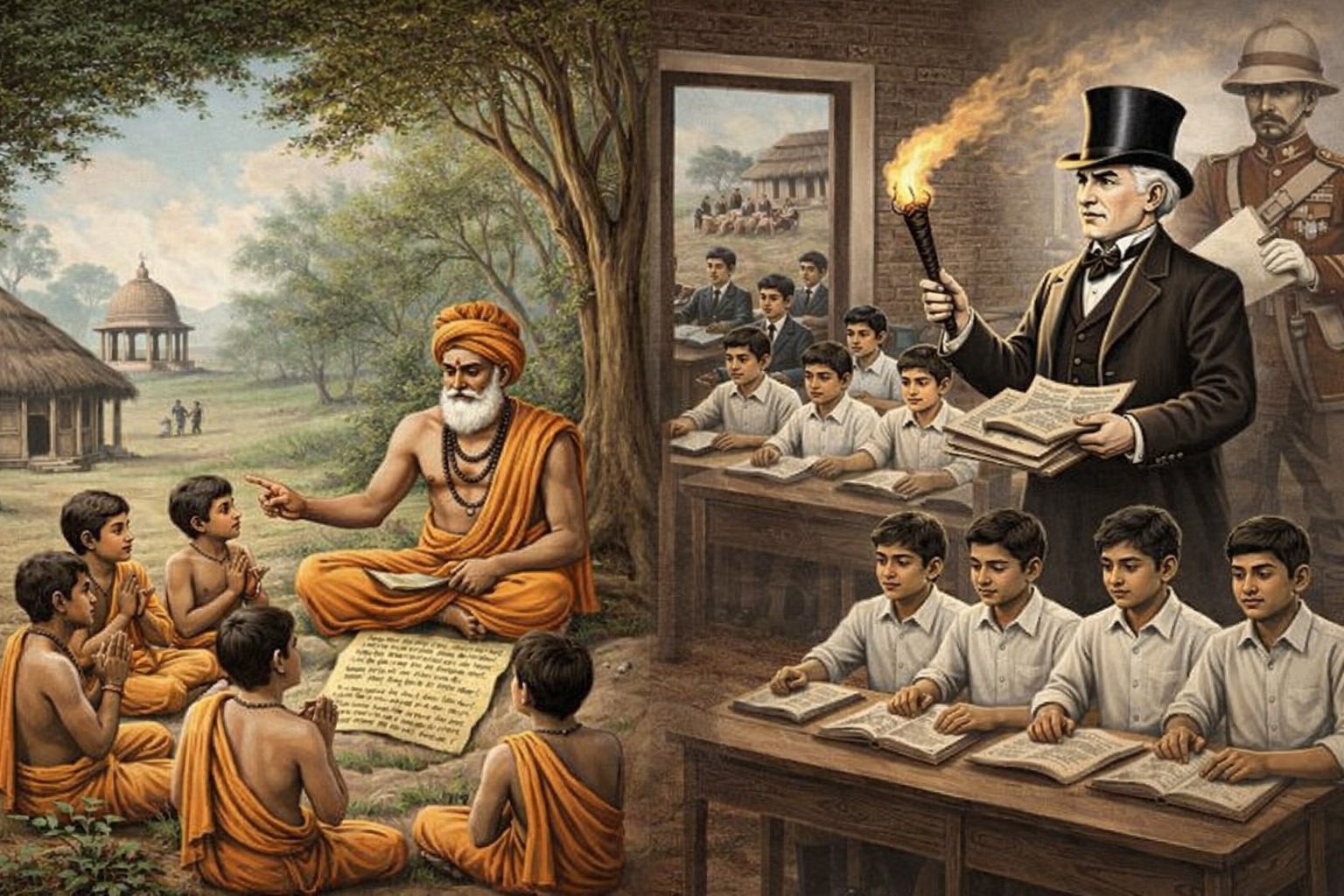
The entry point was education, by undermining the gurukul tradition and portraying it as inferior. Under Macaulay’s system, now dominant across India, a teacher-student ratio of 1 to 20 is considered ideal. What is rarely acknowledged is that India’s education system had the same ratio even in 1830, a fact recorded by a Christian missionary and included in NCERT textbooks.
Unlike Macaulay’s rote-based system, gurukuls taught eighteen disciplines, including Vedic mathematics, astronomy, metallurgy, medicine, surgery, chemistry, and craftsmanship. Education was accessible to both rich and poor, unlike today, where elite English schooling remains out of reach for most.
CBSE, ICSE, and state boards all function within the Macaulay framework. The village-based acharya-led gurukul system was systematically dismantled. The aim was to sever Hindus from their cultural and religious roots through English language and Western education. Teachers and priests became instruments of conversion under the British Empire.
Missionary Hospitals as Centres of Evangelism
After education, healthcare became the second major tool. While Company hospitals for officials and soldiers were located in cities, missionary hospitals were deliberately established in remote regions. Institutions like the Sardhana hospital near Meerut and hospitals in flood-prone Mokama were missionary creations.

Original name “Forestor Hospital” but renamed as “Kripao ki Mata Aspatal”
Over 150 years, these hospitals evolved into a powerful lobby within Indian healthcare. Organisations such as the Christian Medical Association of India, Catholic Health Association of India, and Emmanuel Hospital Association now run thousands of hospitals and employ tens of thousands of professionals, reaching crores annually. These hospitals openly acknowledge their role as centres of Christian propagation.
ICS: Advancing the Missionary Agenda
Education and healthcare alone could not achieve large-scale societal transformation without administrative backing. Hence, ICS (present-day IAS) officers were trained to work in alignment with church objectives. Charles Grant laid this groundwork even before 1813 by establishing a college to train civil servants. Biblical studies, moral instruction based on Christian doctrine, and classical languages were integral to their curriculum.
Even after Company rule ended, Bible-based training for civil servants continued. Literature from the period documents how ICS officers actively supported missionary activities, including conversions, within their districts. The British flag and the Christian cross became inseparable symbols of authority.
A study titled Anglo-Indian Attitudes: The Mind of the Indian Civil Service explores the institutional mindset of ICS officers. It discusses how civil administrators often operated in parallel with missionary networks within their districts. In many instances, administrators either directly or indirectly facilitated missionary activity, which included evangelisation. Assistance could range from administrative cooperation to creating favourable local conditions for missionary institutions.
1813: A Defining Line in Indian History
In the history of India, especially of those rooted in Sanatan Dharma, the year 1813 is a dividing line. Comparative analysis before and after this date explains how a religion with fewer than one lakh adherents became the third largest demographic group within two centuries. In states like Nagaland, Mizoram, Meghalaya, and Arunachal Pradesh, Christians now form a majority. In several others, their population ranges from 10 percent to over 40 percent.
The architects of this transformation, the Clapham Sect, knew their target. That is why phrases like the Great Century of Missionary Work were coined. The data India presents today only confirms what was planned, executed, and institutionalised two centuries ago.