India’s First General Election: Understand How India Created the World’s Largest Electoral History in 12 Points

Every nation needs a system to run its governance smoothly. Different countries follow various forms of government, but the best among all is democracy. Yes, democracy—the rule of the people, by the people, and for the people. It is a system where power lies in the hands of the common citizen. Talking about India, with nearly 991 million (about 100 crore) voters, it is recognized as the world’s largest democracy. But do you know how this giant democracy began? When and how was the first general election held? Who cast India’s first vote? And what challenges were faced during this historic journey of democracy? Let’s explore the answers to these questions.

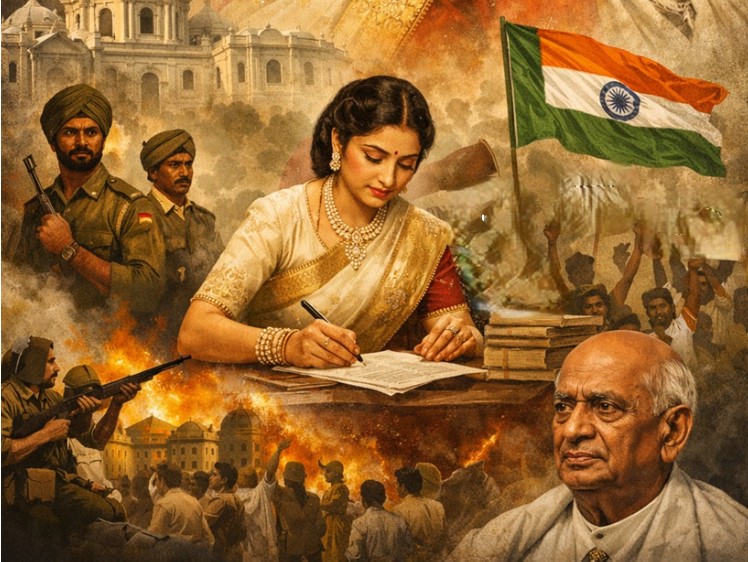
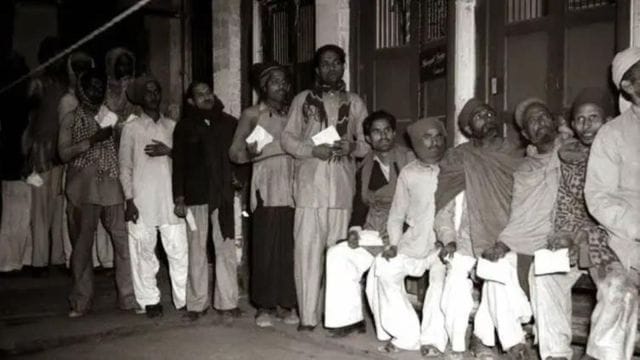
India held its first general elections after independence | Credit: Getty Images
1. When did India’s first general election take place? India’s first general election after independence was held from 25 October 1951 to 21 February 1952. This grand democratic festival lasted 119 days, making it the longest electoral process in Indian history, with voting conducted in 68 phases. At that time, 173,212,343 registered voters participated. This marked a historic milestone that laid the foundation for the world’s largest democracy and established a democratic system in independent India. Simultaneously, voting was held for 3,283 state legislative assembly seats. The first Chief Election Commissioner was Sukumar Sen.
2. What was the system of electing more than one member? During the first general election, the Lok Sabha had 489 seats but only 401 parliamentary constituencies. Some constituencies elected more than one member, which explains this difference. Out of 489 Lok Sabha seats, 314 elected a single representative each, 86 seats elected two members each, and from the North Bengal parliamentary constituency, three members were elected. This multi-member constituency system lasted only until 1957 (five years).
3. Why was a dummy election conducted? At the time of the first general election, 85% of the population was illiterate. To familiarize the overwhelmingly illiterate (around 85%) populace with the voting process, the Election Commission organized a dummy or mock election in September 1951, before the actual elections. People struggled to understand how to cast their votes because voting was an entirely new experience. This mock election helped educate voters on how to use ballot papers and ballot boxes.
4. Why were 2.8 million women’s names removed from the voter list? Preparing the voter list for the first general election was a massive challenge, especially for women. Particularly in rural areas, many women hesitated to register their own names. Instead, they preferred to be recorded as “someone’s mother” or “someone’s wife.” Due to this social conservatism, about 2.8 million women’s names had to be removed from the voter lists because their exact names were not recorded. This reflects the social mindset of that time and highlights the unique challenges the Election Commission faced.
5. Who cast India’s first vote, and where? India’s first vote was cast on 25 October 1951 in Chini (now Kinnaur), tehsil of Himachal Pradesh, by Shyam Saran Negi. He was the country’s first voter and passed away in 2022 at the age of 106. Why did voting start first in Himachal? Because the region’s hilly geography meant heavy snowfall during winter, voting in January-February was impossible. Thus, voting began earlier in October in Himachal so that the people there could exercise their electoral rights without hindrance.
6. What kind of enthusiasm did people show for the festival of democracy? The devotion towards democracy in independent India was so profound that in a village in Kerala, a young man carried his 90-year-old mother on his back through mountainous terrain to reach the polling station. Since there were no roads at the time, the journey took several hours, but the young man said, “My mother’s first vote is necessary for nation-building.” This story beautifully illustrates the enthusiastic participation of rural India.
7. How was the voting process explained to 85% illiterate voters? To educate the 85% illiterate voters, the Election Commission produced a documentary film that was shown free of charge in over 3,000 cinemas nationwide. The film dramatically explained the process of voting. Additionally, awareness was spread through street plays, broadcasts on All India Radio, and screenings in cinemas. This initiative was so successful that it helped millions understand voting, significantly increasing participation. A total of 105.9 million people cast their votes, marking a historic moment. This unique effort raised the voter turnout to 45%.
8. What was the voting age in the first general election? Before independence, only wealthy landlords and merchants had voting rights. India rejected the Western models and decided to hold general elections based on adult suffrage, allowing all people to vote. The voting age during the first Lok Sabha election was 21 years. It was only in 1989, under Rajiv Gandhi’s government, that the 61st Constitutional Amendment lowered the voting age to 18.
9. Which party secured the majority in the first general election? Around 53 political parties participated in India’s first general election, including 14 national parties. Among them were the Indian National Congress, the Communist Party of India, the Socialist Party, the Kisan Mazdoor Praja Party, the Akhil Bharatiya Jana Sangh, the Akhil Bharatiya Ram Rajya Parishad, and the Akhil Bharatiya Hindu Mahasabha. A total of 1,874 candidates tested their fate in this historic democratic contest. The Congress Party won 364 seats, gaining an absolute majority, and Pandit Jawaharlal Nehru became India’s first elected Prime Minister. The Communist Party of India (CPI) stood second with 16 seats. The Bharatiya Jana Sangh won 3 seats, the Hindu Mahasabha 4, and the Ram Rajya Parishad secured 3.
10. When and how was the Election Commission of India formed? The Election Commission of India was established on 25 January 1950 — a date now celebrated nationwide as National Voters’ Day. It was constituted under Article 324 of the Indian Constitution, with Sukumar Sen serving as the first Chief Election Commissioner from 21 March 1950 to 19 December 1958. Initially, the Commission had only one member — the Chief Election Commissioner. However, between 16 October 1989 and 1 January 1990, three commissioners were appointed, and from 1 October 1993 onward, the system of having three commissioners was made permanent. The Election Commission of India conducts elections for the offices of the President, Vice President, both Houses of Parliament (Lok Sabha and Rajya Sabha), and the legislative assemblies and councils of the states. Meanwhile, the responsibility for conducting elections to panchayats and municipal bodies lies with the State Election Commissions.
11. How was the election process conducted? Each candidate was allotted a separate ballot box marked with their election symbol. These boxes were placed in different colors to help voters easily identify them. The ballot paper was about the size of a one-rupee note, and every paper carried the respective candidate’s symbol. Polling stations deployed volunteers and officials to help voters understand the procedure. According to historian Ramachandra Guha’s “India After Gandhi”, 224,000 polling stations were set up across the country. About two million iron ballot boxes were made, requiring 8,200 tons of steel. The Election Commission spent about 60 paise per voter during the first Lok Sabha election — a figure that rose to ₹72 per voter by the 2019 elections.
12. Which prominent leaders lost in the first general election? Although the Indian National Congress achieved a decisive victory in the 1951–52 elections, several renowned leaders faced defeat. These included Dr. B.R. Ambedkar, Acharya J.B. Kripalani, N.G. Ranga, Durgabai Deshmukh, and Mosalikanti Tirumala Rao. The most striking loss was that of Dr. B.R. Ambedkar. Under the banner of the Scheduled Castes Federation, he fielded 35 candidates, of whom only two managed to win. Contesting from North Bombay, Ambedkar lost to his own former personal assistant, Narayan Sadoba Kajrolkar, who ran on a Congress ticket.
The successful conduct of India’s first general election firmly established the nation as the world’s largest democracy and laid a strong foundation for all future elections. The efficiency and credibility of the Election Commission not only strengthened India’s democratic ethos but also inspired other newly independent nations. Today, as we look back at this monumental event, it continues to remind us of the power of democracy and the importance of every voter’s participation.