How a “Dead Constable” Became the British Raj’s Key Witness to Hang 172 People in the Chauri Chaura Case

Imagine a dead man walking into court to testify, and 172 people sentenced to death based on his word. It sounds like fiction; no one would believe it. Yet this happened, buried in history’s pages. It’s the story of the 1922 Chauri Chaura incident in Gorakhpur, where the British decided hundreds of farmers’ fates with scraps of paper and anonymous statements. Their star witness? A constable from the British Indian Police, already declared dead by his own superiors.
The British judge took every word from this “dead” constable as gospel, dooming 172 Indians to the gallows. Who was this pawn the empire used to set an example of terror? Chauri Chaura was less about justice, more a web of conspiracy and cruelty. Here, we uncover those brutal, untold angles.

Villagers protesting in front of the Chauri Chaura police station against the oppressive policies of the British | Image Source: Hindustan Times
On February 2, 1922, villagers in Gauri Bazar near Gorakhpur gathered peacefully to protest soaring prices, liquor shops, and crushing rents. British police deliberately turned discipline into chaos, lashing out with batons and arresting many. Thousands of protesters returned on February 4 outside the Chauri Chaura station. Suddenly, police opened fire on the nonviolent crowd, killing three innocents. Enraged, the mob attacked the policemen and torched the station, claiming 22 lives. Slyly, the British padded the death toll by listing Constable Raghubir Singh among them.
By calling Raghubir “dead,” they inflated the numbers to paint it as an organized, bloody rebellion. But in court, the evidence was thin. Seven months later, on September 22, 1922, the “martyr” Raghubir surfaced alive. The British coached him to testify he’d been away on personal business in Munder market, learned of the blaze on his way back, and hid in farmer Hiralal’s orchard. Around 10 p.m., sub-inspector Lakshman Singh pulled him out and took him along. This “resurrection” became the case’s first explosive twist.
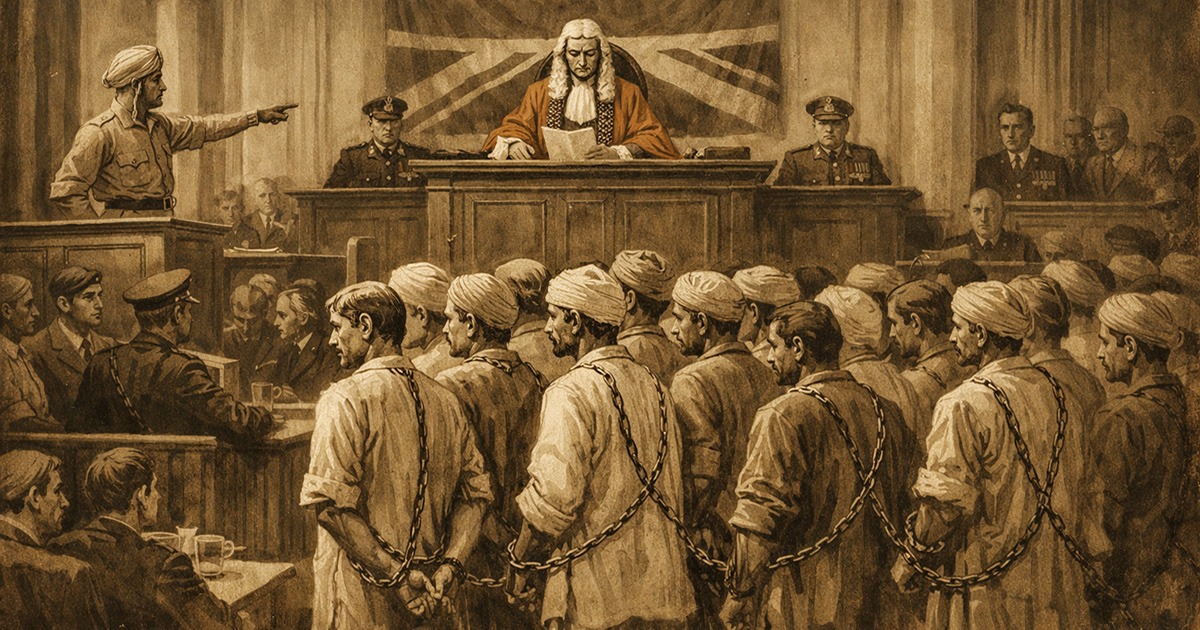
In Gorakhpur Sessions Court, Judge H.E. Holmes paraded Raghubir as the living proof. For seven months, the British had kept him in secret custody: no lawyer, no family–to prep his testimony. Judge Holmes swallowed it whole, sentencing all 172 accused villagers to hang. Handing down 172 death penalties at once was unheard of; the empire’s savagery sparked national outrage. Enter freedom fighter and lawyer Madan Mohan Malaviya.

Martyr’s Memorial, Chauri Chaura | Image Source: The Print
Malaviya challenged Holmes’s verdict in the Allahabad High Court. How could anyone identify culprits through the smoke and flames? His ironclad arguments for the villagers won out: the 172 death sentences, built on Raghubir’s word, were quashed. Still, the vengeful Raj sentenced 19 via the High Court.
Beyond those 19 hangings, two villagers died in police custody. Fourteen got life imprisonment, 19 drew eight years of hard labor, 57 got five years, 20 faced three, and three revolutionaries served two. Thirty-eight walked free. The British pulled it off by propping up Constable Raghubir. The outrage fractured public faith in the empire, fueling the push to independence in 1947. Chauri Chaura’s shadow played its part in breaking the chains.