From Sringeri to Sharda Peeth: How Karnataka Sent the Goddess Back to Kashmir After 76 Years

Sharda Peeth, a world-renowned centre of learning, philosophy, and Sanskrit scriptures, fell victim to invasion by pro-Pakistan tribal militias and Islamic radicalisation following the 1947 partition of India. Yet it was still within the borders of India. But it was on January 1, 1949, when Sharda Peeth, the sacred seat of knowledge, was cut off from its own civilisation, worship stopped, and pilgrimage ended after Pakistan occupied a part of Jammu & Kashmir, which came to be known as Pakistan-occupied Kashmir. And with this, Sharda Peeth slowly crumbled into silence.

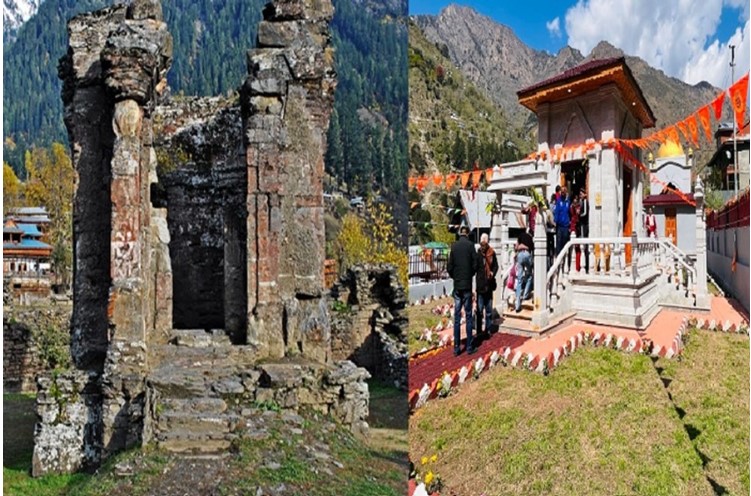
The original Sharda Peeth in PoJK and the new Sharda Temple at Teetwal in Kashmir | Image Source: Panchjanya
To understand how a jewel of India’s intellectual heritage was lost, and how its legacy is now being reborn, we must first return to the final journey pilgrims took toward Sharada Peeth in 1947.
The Final Journey to Sharda Peeth in 1947
In September 1947, one last time, the Kashmiri Pandit pilgrims walked the ancient route from Kupwara into the Neelum Valley, carrying saffron flags as they approached Sharda Peeth in Shardi village near Muzaffarabad. Now, across the Line of Control in Pakistan-Occupied Kashmir, that same temple stands roofless and in ruins. Once a great centre of learning, now surrounded by tea stalls, cafés, and military posts. With no access to their Sharda Peeth, devotees have now built a Sharda Mata Temple in Kashmir. When a new murti of Sharda Devi travelled from Sringeri Matt, Karnataka, to Teetwal, Kashmir, it was far more than a religious ceremony. It was a part civilisational return after 76 years. We bring you the story of how we lost access to Sharda Peeth in 1947 and the complete subsequent decline of the temple’s structure.
1947: Partition, the 1947 War, and the Silencing of a Sacred Centre
The conflict began on 22 October 1947, when Pakistan invaded Kashmir, overrunning Muzaffarabad and the Neelum Valley within days. Sharda Peeth — located just 10 km from the invasion route — fell behind enemy-held territory.

Sharda Peeth, a major center of civilization was destroyed | Image Source: X
The centuries-old Sharda Yatra, recorded well into the 1930s, abruptly ceased. With the 31 December 1948 ceasefire, the Line of Control sliced Kashmir in half, placing Sharda Peeth in what became Pakistan-occupied Jammu & Kashmir (PoJK). For the first time in history, access to the shrine that had been there since at least the 6th century CE was cut off. A civilisational centre went silent, and Hindus had no access to it.
The Journey Back to Kashmir
The revival begins in the south, at Sringeri Sharada Peetham in Karnataka, established by Adi Shankaracharya in the late 8th century CE (c. 788–820) to carry forward the tradition of Kashmir’s goddess of learning.

The Sharda Temple at Teetwal and the idol of Sharda Maa donated by the Sringeri Matha | Image Source: Navbharat Times
In early 2023, Jagadgurus Sri Bharati Tirtha and Sri Vidhushekhara Bharati consecrated a new murti of Sharada Devi, crafted over two years. On 7 March 2023, the murti left Sringeri and began its 2,500-km journey north. Passing through Bengaluru, Hyderabad, Nagpur, Delhi, and Jammu, the procession drew thousands, a symbolic return of Kashmir’s lost deity after the rupture of 1947.
A New Mandir Along the Line of Control
On 20 March 2023, Sharada Devi reached Teetwal in Kupwara district, just 2.5 km from the LoC. Here, a Sharda Temple, originally destroyed during the October 1947 tribal attacks, had been reconstructed by local organisations and devotees. The new mandir was inaugurated on 22 March 2023, coinciding with the spring festival of Navreh. It stands facing the direction of the original Sharda Peeth across the border, as if keeping vigil. For the first time since Partition, worship of Sharada Devi returned to the Kashmir Himalayas — on Indian soil.
Why a New Temple Was Needed
A new Sharda Mandir became a historical necessity after 76 years of lost access. Sharda Peeth was once the intellectual heart of Kashmiri Pandit identity, referenced in the Nilamata Purana (6th–8th c. CE) and in Kalhana’s Rajatarangini (c. 1148–1150 CE) as the seat of Kashmir’s goddess of learning. Pilgrimages were recorded annually until 1947. With Partition, the entire Sharda tradition lost geographic anchoring in its birthplace. Building a new temple in Teetwal restores pilgrimage continuity, revives cultural memory, and ensures that Kashmir’s knowledge deity returns to the valley even if the original site remains under foreign control.
What Happened Across the Border to the Original Temple
Across the LoC, the condition of the original Sharda Peeth deteriorated rapidly. In 1915, Aurel Stein photographed the shrine still structurally sound; in 1931, archaeologist R. C. Kak described it as largely intact, with a complete sanctum and surviving superstructure. Today, the site — under Pakistan’s control — shows a collapsed roof, missing stone blocks, and no formal conservation. Reports between 2017 and 2023 document cafés, tea stalls, and military installations emerging around the precincts, trivialising one of South Asia’s oldest universities. This neglect is not accidental but reflects a pattern of institutional disregard towards pre-Islamic heritage in PoK.
What the New Mandir Represents
The Sharda Mandir of Teetwal (2023) stands as a counter-history — a declaration that even if borders divide, memory will not. Situated metres from the LoC, it faces the ruins of Sharda Peeth in silent guardianship. It embodies a truth that India cannot afford to forget: sacred geographies survive when they are remembered, restored, and lived. Until Sharda Peeth itself is conserved, protected, and acknowledged for what it once was — a global centre of Sanskrit learning — the new temple ensures that the goddess has returned to her mountains. And it affirms that Hindu civilisation, displaced in 1947, refuses to allow its knowledge centres to disappear.