Exposing Evangelism Part 2: “The Same Miracle, Everywhere”: Notes From a Case Diary Through Eyes of Data Analyst

I didn’t begin an investigation on Evangelism and fake healing expecting a pattern. It started as a regular part of media monitoring of evangelical forces in May 2025, a small police brief buried deep inside a district crime report from eastern Uttar Pradesh — a complaint about a “prayer meeting” where illness was promised to vanish without medicine. These were all reported cases in the mainstream media.
A month later, another case surfaced in Chhattisgarh. Then Madhya Pradesh. Then Maharashtra. Different states, different pastors, different villages—but the same modus operandi. As I traced FIRs, court orders, and local testimonies across India through May to December 2025, a disturbing chronology emerged: Fake healing meetings were not isolated acts of faith gone wrong, but a repeatable method, deployed again and again to exploit illness, poverty, and belief—often ending not in cures, but in criminal charges, broken families, and silent coercion. This is the story of how that pattern revealed itself, case by case, date by date, through the eyes of a journalist following the trail where miracles were promised—and the law was eventually forced to intervene.
1. May 2025: The First File
I first noticed the pattern in mid-May 2025, when a case landed on my desk from Belhari Bag, Akbarpur (Uttar Pradesh). A small room, recently converted into a prayer hall displayed a promise: “Your illness will end today.”
Was this about belief or coercion? The accused had claimed divine healing, collected Hindu religious items from the home, offered Rs. 50000, and demanded conversion to Christianity in return. When police arrived, they seized religious pamphlets and vehicles. An FIR was registered under the state’s Religious Freedom Act. At the time, it looked isolated. I was wrong.
2. June 2025: Different States, Same Script
By June, reports began arriving from Jabalpur (Madhya Pradesh) and Pilibhit (Uttar Pradesh). In Jabalpur, a sick woman was told she would recover only if she accepted a new faith. They offered 2,000 rupees and promised better health and financial benefits to pressure her into conversion.

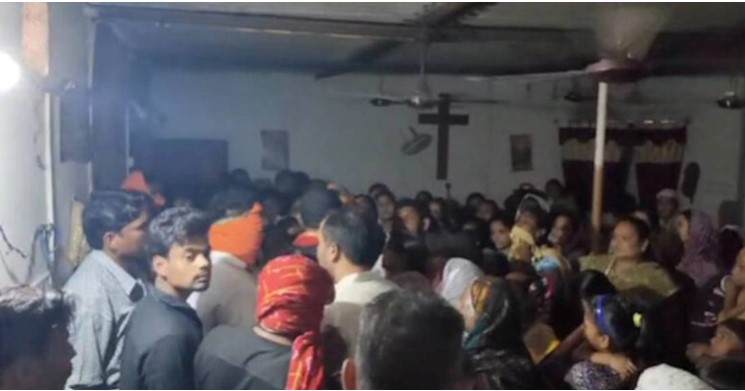
Over 150 villagers gathered during fake healing event in Saraswati Nagar, Raipur, Chhattisgarh
In Pilibhit, a woman was taken to a river, blindfolded, and made to perform rituals after being told her illness was caused by her “old beliefs.”
Every statement repeated the same structure:
- Identify sickness or vulnerability
- Claim instant healing through prayer
- Attach healing to conversion
- Escalate to threats or repeated pressure
By now, it was no longer coincidence. A template was emerging.
3. July–August 2025: The Expansion
In July, police disrupted a prayer gathering in Vishunpura (UP). The main organiser fled. Others were detained.

Changai Sabha at Bilaspur, Chattisgarh exoposed by local Hindu Activists
In August, FIRs were registered in Bilaspur (Chhattisgarh) and Islamnagar (UP). The term “changgai sabha” appeared again and again — gatherings marketed as healing meetings, later turning into conversion drives. Police registered an FIR under the Religious Freedom Act and BNS Section 299, and arrested Pastor Sukhnandan Lahre and Raghunandan Lahre.
4. September 2025: When the Crowd Grows
In Nigohan, Malkhan, Uttar Pradesh, a pastor held gatherings in a house on his farm. He performed fake miraculous healings on sick villagers, including a boy with epilepsy, claiming prayers would cure them. He offered money and benefits to attract people, pressuring women and children to adopt Christianity through baptisms. In Hazaribagh (Jharkhand) and Bundia (Chhattisgarh), gatherings grew larger. Entire villages were invited. Some accused promised that no one would ever fall sick again after conversion. Others guaranteed hospital treatment, which never came.
5. October–November 2025: Foreign Links, Repeat Offenders
In October, a case from Bhiwandi (Maharashtra) stood out. One accused was a foreign national. James Watson and others used fake healing to push villagers to adopt Christianity in Bhivandi. Fake healing demonstrations were performed publicly. Christian literature was distributed. Police arrested three people.
In November, a chargesheet in Agra named eight accused who had lured around 80 families with healing promises, education offers, and job assurances.
By now, I could trace the movement:
- House → village → district → state
- Always targeting the poor, sick, or socially isolated
- Always disguised as “prayer” or “celebration”
December 2025: The Case That Went Viral
The final file of the year came from Pune, dated 9 December 2025. A video had gone viral. A pastor claimed he had cured a woman of AIDS during a Christmas-themed event. Police arrested him. When I closed the file, the pattern was undeniable. Different names. Different states. Same miracle. Same method. Same victims.
What Does the Story Reveal
Belief is protected. Fraud, coercion, and forced conversion are not. Across May to December 2025, case after case showed how: Fake healing claims were used as leverage, and vulnerability was exploited. This wasn’t a spontaneous movement. It was organised, repetitive, and systematic.