During Christmas of 1934, Gandhi Stayed Up 30 Minutes Late to Learn More About the RSS from Dr. Hedgewar Ji

On the night of 25 December 1934, long after the lamps of Wardha’s Satyagraha Ashram were usually extinguished, Mahatma Gandhi chose to stay awake beyond his customary hour. The reason was neither political urgency nor a crisis of the freedom movement, but a quiet curiosity about an organisation he had just encountered for the first time: The Rashtriya Swayamsevak Sangh.
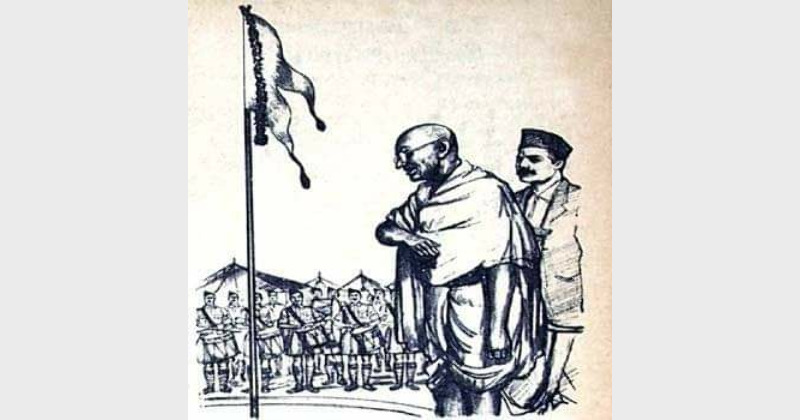
A day earlier, during the Christmas vacation period, Gandhi had visited an RSS training camp on open ground along the Wardha–Shegaon Road. Nearly 1,500 swayamsevaks had gathered there, irrespective of caste or creed. All having arrived at their own expense, carrying their own bedding and provisions, they lived together in conditions that were austere yet remarkably orderly. What struck Gandhi ji was not merely the numbers, but the atmosphere — discipline without coercion, simplicity without disorder, and a striking sense of equality. Young men of different castes ate, worked, and lived together without distinction. The impression lingered in Gandhi’s mind.
So when Dr. Keshav Baliram Hedgewar Ji, founder of the RSS, arrived in Wardha the following evening, Gandhi invited him to the ashram for a private conversation at 8:30 p.m., a time already close to his usual bedtime. Present were Mahadevbhai Desai and a few close associates. They sat simply on mattresses spread across the floor, and began a discussion that would quietly stretch well into the night.
Gandhi began by recalling what he had witnessed at the camp. He spoke of the calm order among the youth, the absence of chaos despite large numbers, and the uncommon sight of Hindus across social divisions living as equals.
He then questioned Hedgewar Ji on the foundations of the Sangh, its discipline, its organisation, and its finances. How, he asked, could such a large body function without external funding? Hedgewar Ji replied that the Sangh depended entirely on voluntary guru dakshina and that every swayamsevak bore his own expenses. The organisation, he explained, had consciously chosen self-reliance over patronage.
The conversation then turned to politics. Gandhi asked why Hedgewar Ji, once associated with the Indian National Congress, had formed a separate organisation. Hedgewar Ji answered with measured clarity: While the Congress mobilised volunteers for political objectives, the Sangh sought to build men of character, capable of serving the nation beyond immediate political aims.
As the clock edged toward 9:00 p.m., Meeraben gently reminded Gandhi that it was time for him to rest. Sensing the hour, Hedgewar Ji rose to take leave. Gandhi, however, waved the concern aside.
“Oh no,” he said with a smile. “We can continue our conversation for a while. I can easily stay awake for another half hour.”
That additional half hour became the most revealing part of the evening. Gandhi pressed further on what it truly meant to be a swayamsevak, how discipline was sustained without compulsion, and how equality was practised in daily life. Hedgewar Ji replied that a swayamsevak was not a follower but a self-motivated servant of the nation, trained to reject discrimination in thought and action.
Doctor Ji had said: “A Swayamsevak is a leader who is prepared to surrender his mind, heart, soul, and all his resources for the all-round progress of the nation. In the Sangh, we focus on building the character of such swayamsevaks. We always remember that we are all swayamsevaks, that we are equal, and that we love everybody to the same degree. We do not support any kind of discrimination. That is the secret of the rapid growth of the Sangh work, that too, without money or any other facilities.”
Gandhi listened intently. He paused when Hedgewar Ji mentioned that he neither practised medicine nor led a family life, having devoted himself entirely to the Sangh. The admission appeared to surprise him, and he acknowledged it with quiet recognition.
When the meeting finally drew to a close, Gandhi walked Hedgewar Ji to the ashram door. In the stillness of the Wardha night, he offered a parting remark that would linger in memory: “On the strength of your character and your unshakeable faith in your work, you will certainly succeed in your endeavour.”
Thus ended a Christmas evening unlike any other, one in which India’s most revered leader chose to stay awake not to persuade, not to debate, but simply to understand.